


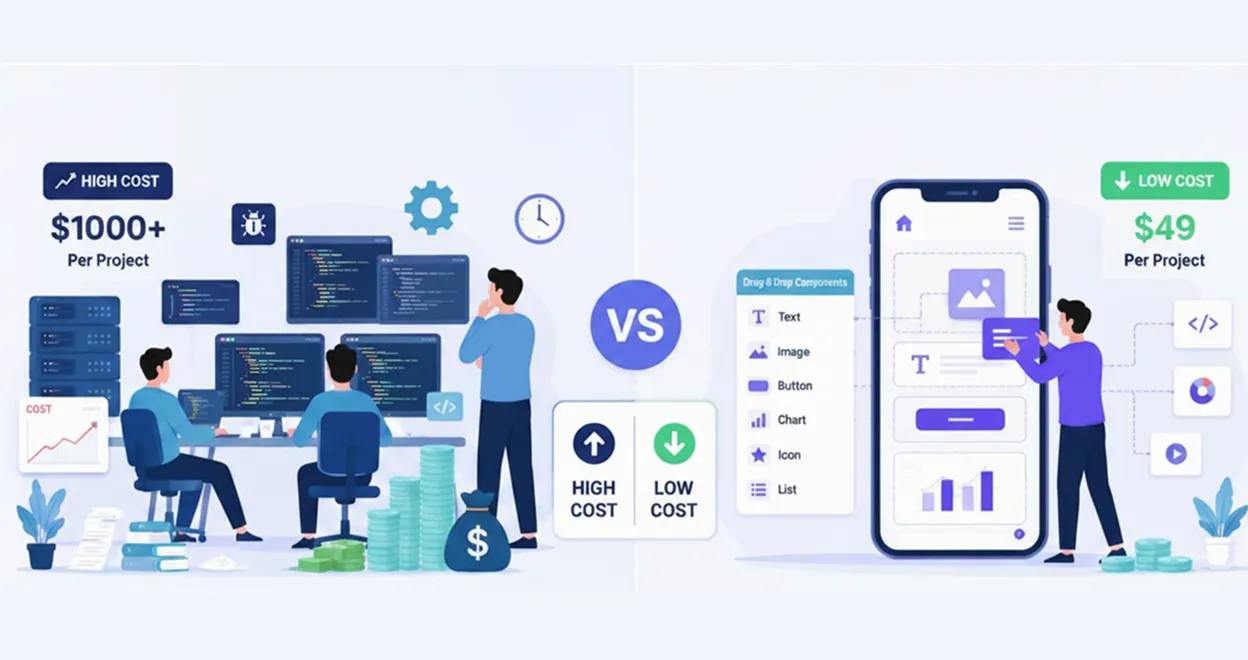
Low-code app development and traditional app development: What is the price difference?
Published on:
7 May, 2026

You are a small business owner with a brilliant mobile app idea, but it would take 9 months with a budget increasing over time. By the time your app is developed, the market has already moved on. This is the scenario of traditional app development for businesses. Users will not wait that long. They want faster and more recent technology apps for engagement.
Low-code app development comes in as a solution. It makes the app development process easier and quicker. This approach works without complex coding and technical skills. It is a modern way to build mobile apps that saves time, resources, and effort.
In this blog, we will break down each of low-code and traditional app development in a simplified way with their features, benefits, use cases, a cost-specific comparison, and a real-world example.
What is low-code app development?
Low-code app development is a simple approach to building your mobile app. It uses custom-built templates and elements with a drag-and-drop visual editor. This approach lets skilled developers and non-technical people build mobile apps quickly. Low-code app development may require basic knowledge of coding for more advanced functionality.
6 Features of Low-code app development
Below are a few features that make low-code app development different from traditional app development.
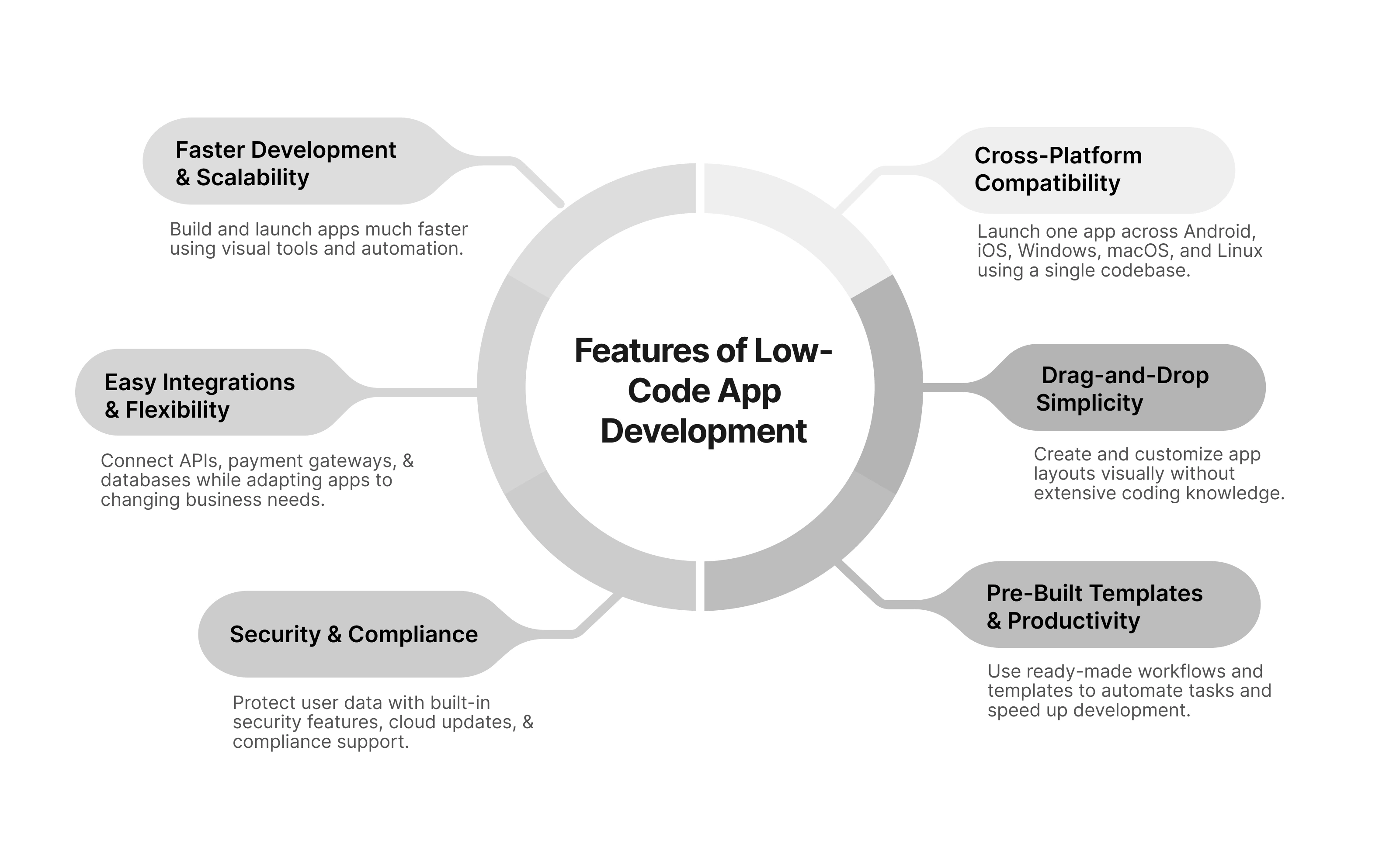
1. Scalability
As your business grows, your mobile app should also grow. Low-code app builders make it easier to add new features to modify your mobile app without beginning from scratch. So, you can walk with current market trends and customer demands.
2. Integrations
Low-code tools have custom-integrated apps that can easily connect with your app and databases. No complex setup, saving time and effort. It includes in-app purchases, in-app preview, payment gateways, and more
3. Security and Compliance
Low-code apps should be built with strong security measures to keep the client's personal information safe and protected from being lost and misused. Most low-code tools are cloud-based, which automatically updates.
4. Cross-platform compatibility
A mobile app built with a low-code mobile app builder works smoothly across platforms. The low-code platform should support Android, iOS, Linux, Mac, and Windows. One codebase runs on different platforms.
5. Drag-and-Drop Elements
This is one of the important features of low-code platforms that actually benefits the non-developers. The user can change the position, fields, and buttons using the drag-and-drop elements, giving more control over the appearance of the app.
6. Pre-built Templates
Custom-ready templates provide the user with a base to start with the app development. It is basically pre-optimized workflows with logic that follows a pattern, making it easier for non-technical users to make a workflow. For example, the login page workflow and more.
Benefits of low-code app development
According to Hositnger, 31% of the companies use low-code platforms as their primary software strategy.
1. Quicker App Development
Businesses can build apps faster without developers in weeks. Low-code tools eliminate the manual effort of coding with visual editors, templates, and movable elements. Hostinger statistics show app development is 90% faster with low-code platforms.
2. Effective Pricing
According to Kissflow, the low-code app development market is projected to exceed $26 billion by 2027, as adopted across industries such as banking, healthcare, insurance, and retail. The numbers indicate how widely businesses are adopting low-code apps. They are faster to build, cutting more than half of the development cost.
3. Increased Productivity
Low-code app builders create workflows that automate repetitive tasks with minimal coding. It eliminates the need for extensive coding and manual effort to design workflows. It gives businesses more time to focus on delivering a better user experience.
4. Great Flexibility
Low-code platforms are highly adaptable to your current business flow and requirements. It makes it easier for people to make modifications and integrate new functionality within the app with current market trends.
Drawbacks of Low-Code App Development
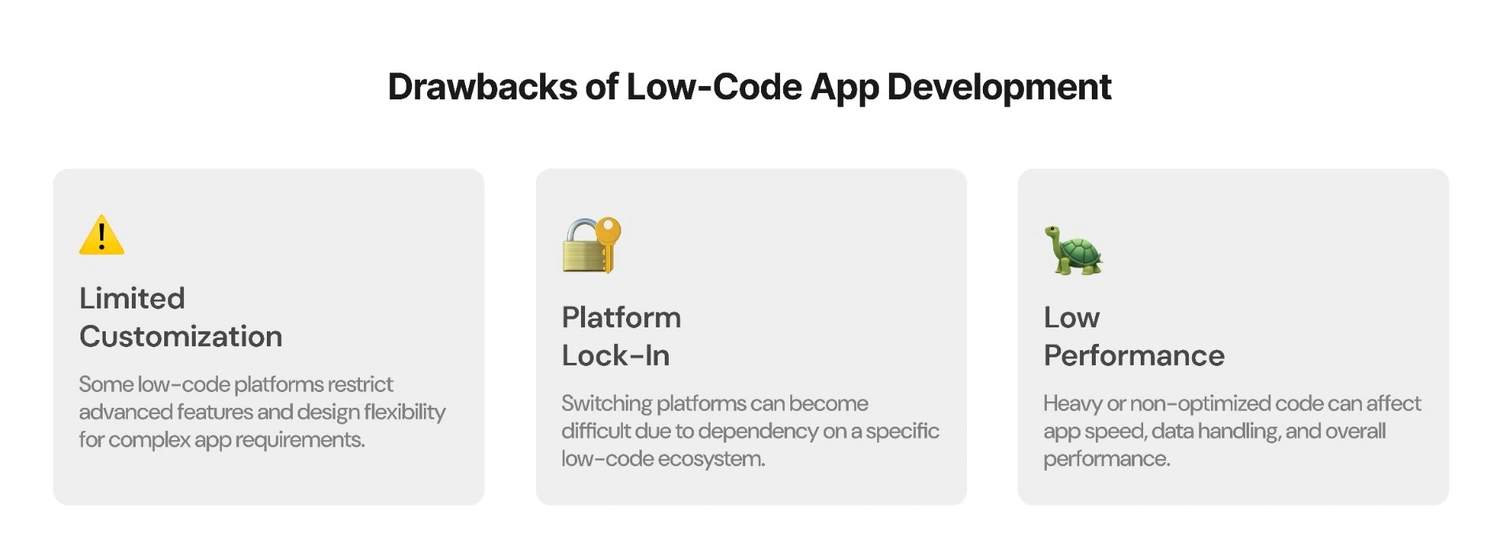
1. Limited Customization
Few low-code apps offer limited customization for the app, which is a major disadvantage of low-code app development. It restricts the user to meet all the app requirements.
2. Platform Lock-in
One of the biggest disadvantages of using low-code platforms for building apps is platform lock-in. Some low-code platforms produce clear and structured code that works smoothly across platforms. But some of the platforms appear to be complex to manage the apps on.
3. Low Performance
Low-code platforms are often built with non-optimized and heavy code, which leads to slow loading speed, improper data handling, and other breaches. This can impact the overall performance of the app.
What is traditional app development?
Traditional app development, also known as custom app development, is a process of building a mobile app using programming languages such as HTML, CSS, JavaScript, C++, and more. It requires professional developers to make an app with this approach. It is ideal for large & high-budget projects and businesses.
Features of traditional app development
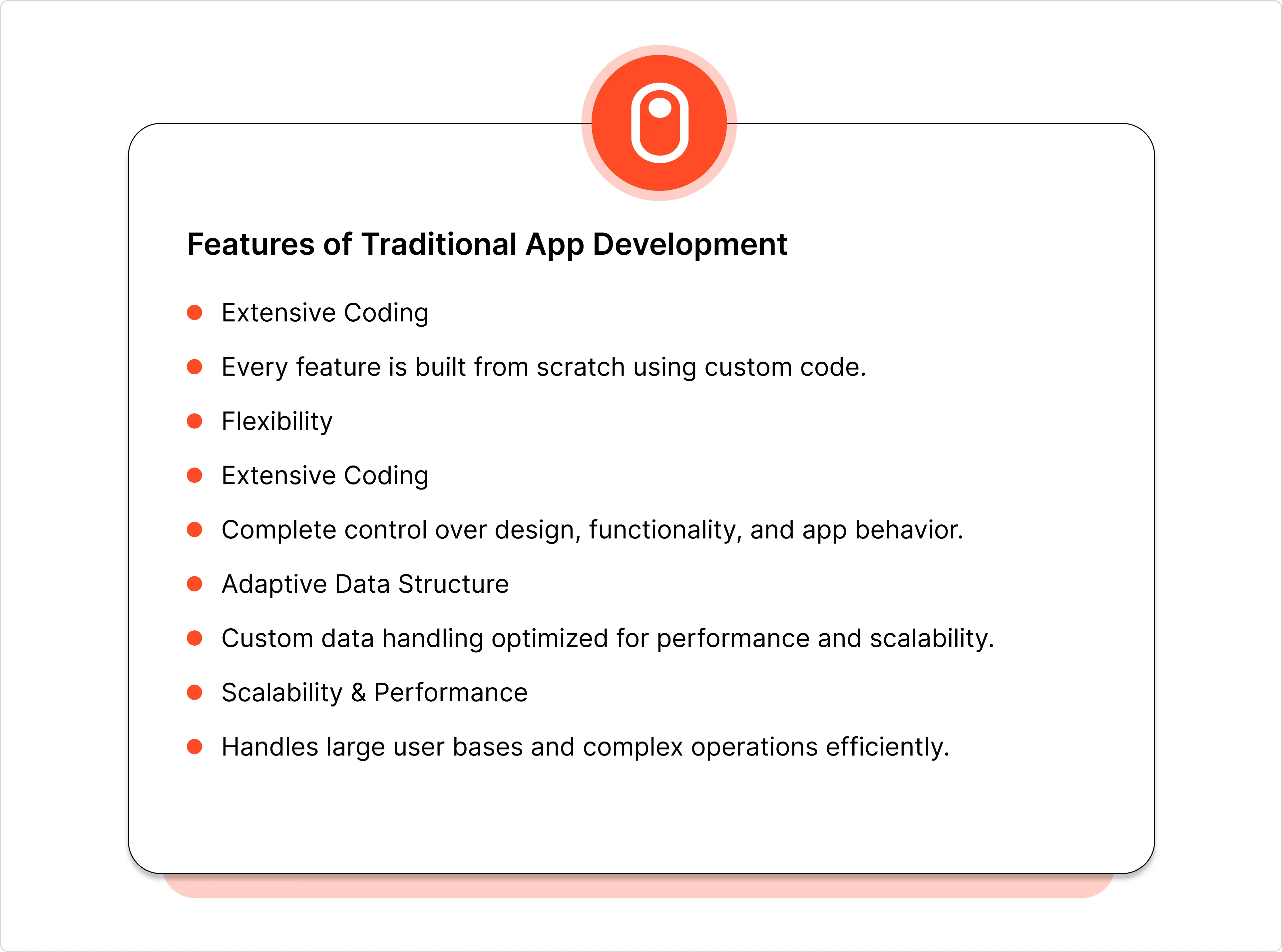
1. Extensive Coding
Every single feature or functionality is written by skilled developers from scratch. It allows them to build even the most complex features as they want in programming languages.
2. Flexibility
Traditional app development gives complete control over how your mobile app will work. This makes it the go-to choice for large and complex projects with no shortcuts. It allows developers to create unlimited design options and functionalities for the app.
3. Adaptive Data Structure
Developers have to structure and store the data in the simplest way that suits the app perfectly. There are no restrictions and limitations. The app should be optimized for speed and performance across platforms.
4. Scalability and High Performance
Mobile apps built with a traditional approach can handle a large amount of data and users, making them highly scalable for your growing business.
Benefits of traditional app development
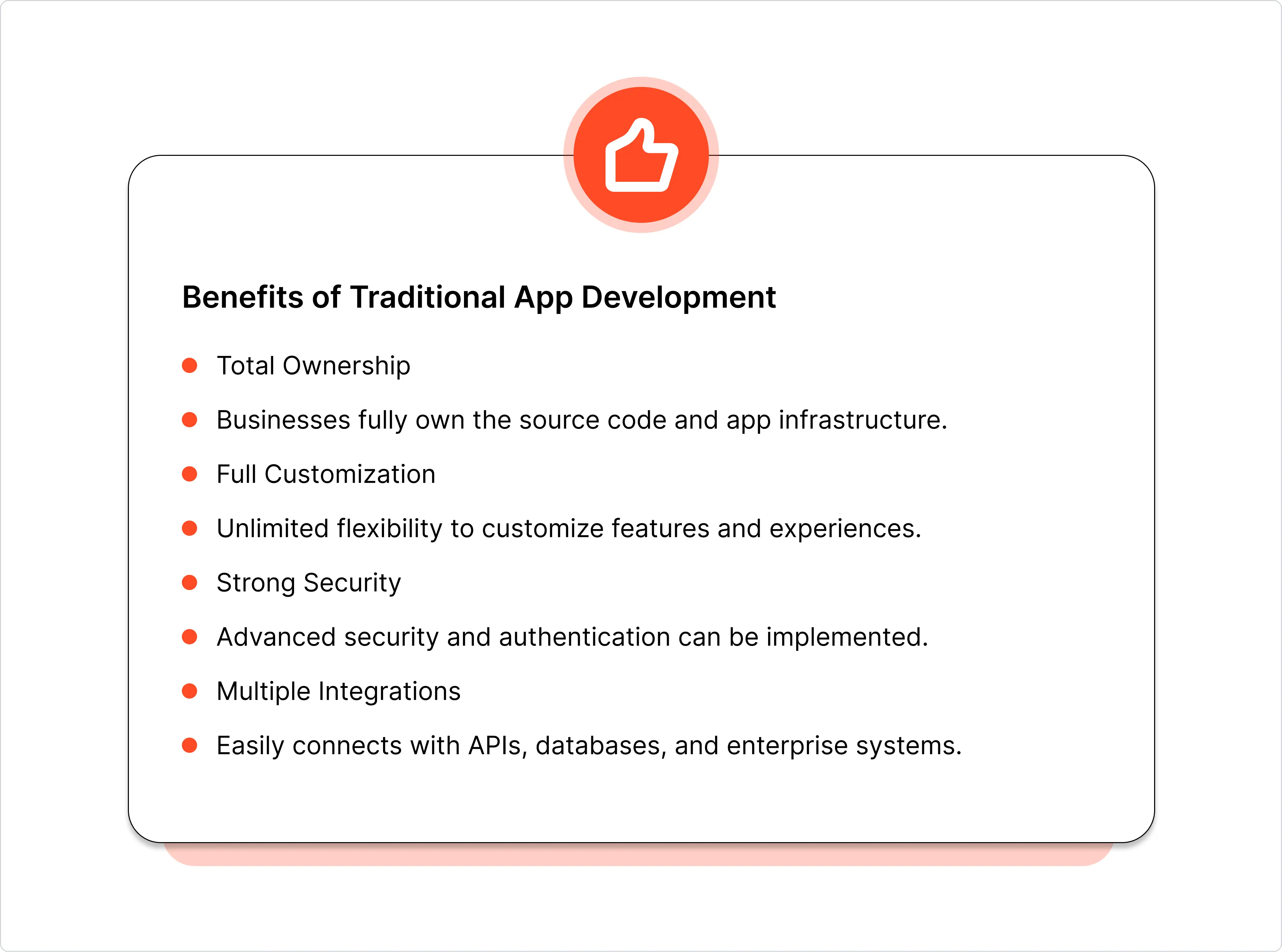
1. Total Ownership
Mobile apps built with traditional app development have complete ownership over their app. The source code is owned by businesses over every element.
2. Full Customization
It offers developers the ability to customize, modify, and adjust the custom code to tailor the app to the requirements. With this approach, customizations are limitless.
3. Proper Security Measures
Businesses can introduce multiple security measures and authentication options to avoid breaches. It helps protect users' personal details and safeguard data.
4. Multiple Integrations
Businesses work on different systems and databases. The traditional approach allows integrating apps through custom-built APIs and code pipelines, ensuring a smooth workflow and functionality of the app.
Drawbacks of Traditional App Development
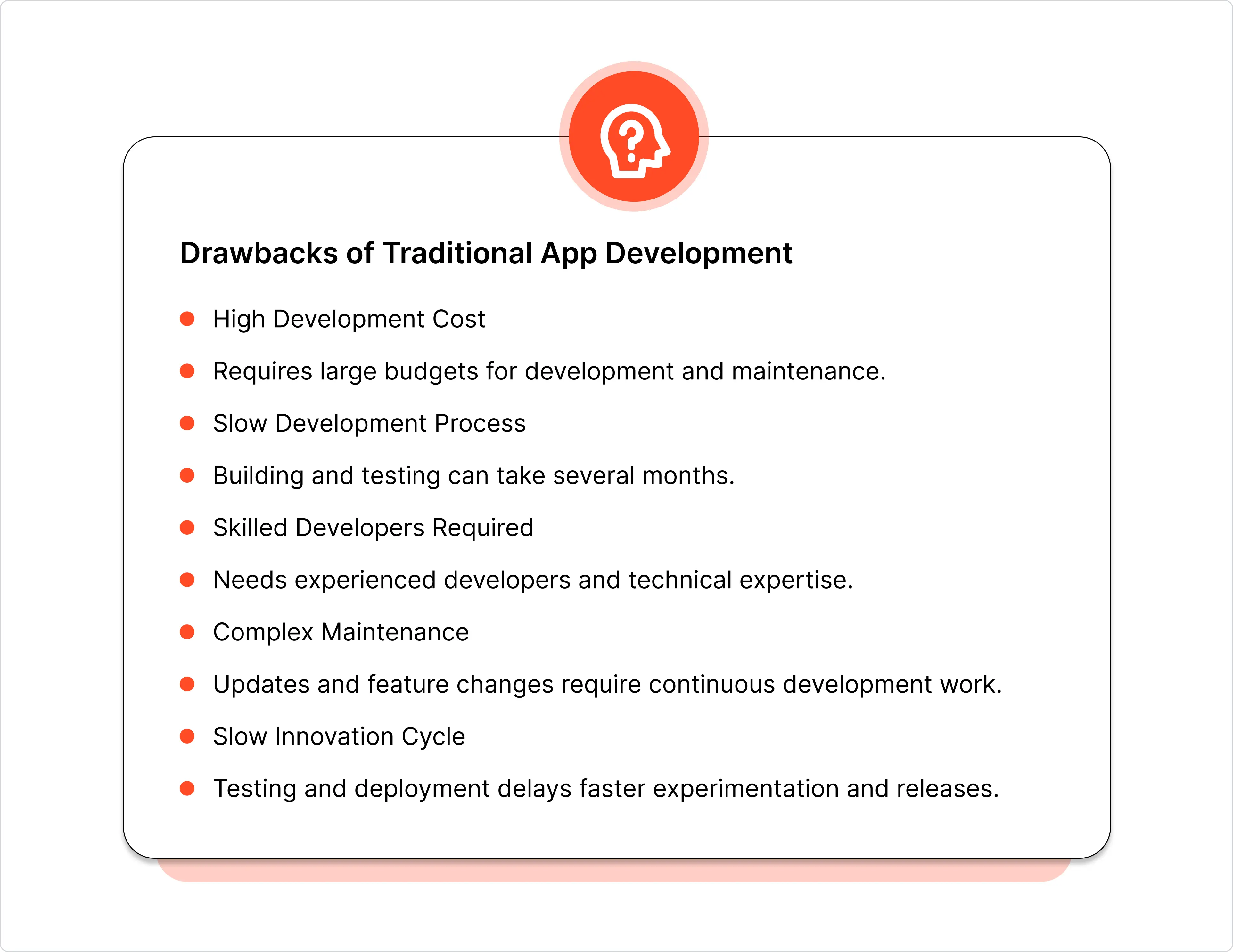
1. Higher Development Cost
To build an app with a traditional approach, businesses need a highly extensive budget. It includes development costs, salaries of developers, costs of new features, deployment costs, and growing app maintenance costs.
2. Slow App Development
Manual app development is a slow process. It takes more than 7 months to design and build an app. Later, the app will be pushed for review and testing, which will take a month or two.
3. Require Highly Skilled Professionals
For a perfectly built traditional mobile app, businesses need highly skilled developers for the desired programming languages. Traditional app development depends on fully knowledgeable professionals.
4. Complex App Maintenance
Traditional app development requires more updates and ongoing maintenance. Even a minor update for a feature requires developers for a smooth flow.
5. Slow Preview
Developing and structuring new ideas usually takes time, delaying innovation. After developing, the testing takes a longer time, which delays meeting the ongoing market trends.
Low-Code Vs Traditional App Development: The Price Difference
| Cost Category | Low-Code App Development | Traditional App Development |
|---|---|---|
| Initial Development Cost | $10,000 - $150,000 | $30,000 - $300,000+ |
| App Launch Time Period | 1 - 3 Weeks | 3 to 11 Months |
| Platform Fees | $25 - $500 Per Month | None |
| App Maintenance | Included in Platform (billed annually) | $20,000 - $85,000 per year |
| Scalability Costs | Increases as users and features grow | Based on the architecture |
| Customization Expenses | Paid plans needed | Included in the development |
| Security Controls | Platform-specific | Fully custom-built |
| Platform Lock-In | High | Low |
| Code Ownership | Platform owned | Fully owned by the business |
| Size of Developers | 1 - 3 people | +15 people |
| Technical Skills | Basic and beginner-friendly | High-skilled developers |
| Risk Level | Low | Higher |
| Update and Maintenance Speed | Faster (handled by the platform) | Slower (requires development involvement) |
| Integration Difficulty | Moderate | Low |
| Best For | Individuals or Growing Businesses | Enterprises or Complex Systems |
Cost Breakdown Analysis:
The cost difference between low-code and traditional app development is quite different. Understanding where the money is used can benefit businesses in making smarter decisions.
1. Initial Investment
The most important thing is how much investment the two approaches begin with. Low-code app development begins with $10,000, making it an approachable option for startups and small businesses who want to build their mobile app with a tight budget.
Traditional app development starts with $30,000 and can go beyond $300,000 depending on the complexity and requirements of the app. The difference is clear: low-code development is better suited to start with a limited budget.
2. Maintenance Costs
Low-code app platforms are priced from $30 to $500 when billed monthly. It includes maintenance, updates, and security enhancements without any hidden costs.
Traditional app platforms have no monthly maintenance, although businesses should have an annual maintenance plan beginning with $20,000 to $80,000. This is the cost that is usually ignored by businesses when choosing the traditional app development approach.
3. Time is Money
Low-code apps can be launched within 1 to 3 weeks of development. While traditional apps take 2 to 7 months to launch. In today’s technology-first world, the faster you race with technology, the more you earn. It indicates that low-code can generate revenue faster while traditional development is still in the development stage.
4. Professionals and Team Requirements
Low-code app development requires 2 to 3 developers with basic technical and coding skills, which means lower labor costs. While traditional app development requires a full-fledged 15-plus developers, each receiving a higher salary. This difference in team size alone can make a difference in the budget, saving more with low-code development.
5. The Hidden Cost
Low-code app builders often charge extra for advanced features and add-ons as technology grows. Traditional development has its own hidden costs, such as architecture setup, quality testing, and other security improvements. Low-code hidden costs appear to be predictable, but traditional development costing can be harder to estimate.
6. Long-Term Picture
The long-term expenses of low-code apps can go beyond $2,400 in total, while traditional apps can cost around $480,000 and go beyond that. Over the years, low-code can go up to $3,999 (approx.) compared to a massive $160,322 (approx.) for traditional app development. These numbers are hard to ignore for any business, whether it is a smaller or a larger one.
<br//>
The Winner: Low-code app development
For businesses that are just beginning their app development journey, low-code app development is a great place to begin. It offers a faster app development process, quicker launch, and lower initial investment as compared to traditional development. However, large organizations often demand extensive customizations, higher flexibility, and scalability, but all of this cannot offset the higher investment over time. Choosing the right low-code app builder can eliminate all these problems, such as WebToNative. This low-code app builder is a great solution for businesses, whether small or large, tailoring to each requirement.
WebToNative: a Low-Code Platform Built for Growing Businesses
WebToNative is a low-code mobile app builder that solves the biggest problem of traditional app development, which is months of app development and hiring an entire team of developers. It converts the existing website into a fully functional mobile app without complex coding. It helps businesses to launch their mobile app quickly with powerful native features and add-ons such as social login, Google AdMob, biometric authentication, in-app updates, and more. WebToNative makes it easier for non-technical individuals and businesses to build their mobile apps without any technical headaches.
Just Simplified Conversion. Unlimited Growth.
A Real Use Case of WebToNative
Travvy is a smart travel platform that helps people plan, explore, and organize their trips in a personalized way. To transform their website into a fully functional mobile app, Travvy chose WebToNative, resulting in an efficient app experience for people.
When a new user opens the Travvy app, the experience feels intuitive and smooth. The onboarding screen introduces the platform, helping them understand how to use the app, core features, and more. Once they are inside the app, everything falls into place naturally. People can explore destinations, tours, packages, and hotels through in-app previews without redirecting to an external website. The mobile app keeps the complete experience of Travvy.
The Travvy app keeps people engaged and connected even when they are not actively using the mobile app through push notifications. It sends instant notifications to people’s screens about booking confirmations, offers, payment success, and trip details straight to their phones.
As travel planning brings many questions, an AI chatbot with 24/7 support is always running to answer all the client queries without making them wait. And as Travvy continues to grow, make sure the new update is automatically downloaded without making people reach app stores for updates.
Travvy is the real proof that you do need months of development and technical skills to develop a great mobile app. With WebToNative, the most innovative ideas can come to life more easily and quickly.
View the apps built with WebToNative on Showcase.
FAQs
Q1. How much does low-code cost compared to traditional development?
A. Low-code app development starts from $10,000 to $150,000, while traditional app development can exceed $300,000, making low-code a far more affordable option for most businesses.
Q2. Is low-code only for small businesses?
A. No, businesses of all sizes use low-code to build apps that automate workflows and launch products faster without the need for large development teams.
Q3. What makes WebtoNative stand out as a low-code solution?
A. WebtoNative converts existing websites into fully functional mobile apps quickly without any complex coding or large development teams.
Q4. Which can build the app faster, low-code or traditional app development?
A. The low-code app development approach builds the mobile app faster, as it eliminates the manual effort of complex coding.
Q5. Can non-technical people use low-code platforms?
A. Yes, low-code platforms are designed to be beginner-friendly and require basic or no coding knowledge.
Q6. What is WebToNative?
A. WebToNative is a low-code app builder that converts existing websites into fully functional mobile apps quickly and affordably, without any complex coding.
Conclusion
Choosing the right app development approach for business depends on the budget, timeline, and business goals. Traditional app development offers complete control and customization but a higher price and more time. Low-code app development makes app building faster and accessible at an affordable price without blowing the budget. The cost comparison between the two app development approaches is not ignorable. Hostinger’s latest statistics and trends research shows that the low-code market growth is increasing globally. The market generated $30.1 billion in revenue in 2024 and is expected to reach $101.7 billion by 2030. Platforms like WebToNative indicate how businesses are using low-code app development to stand out from the competition.
Similar Blogs