
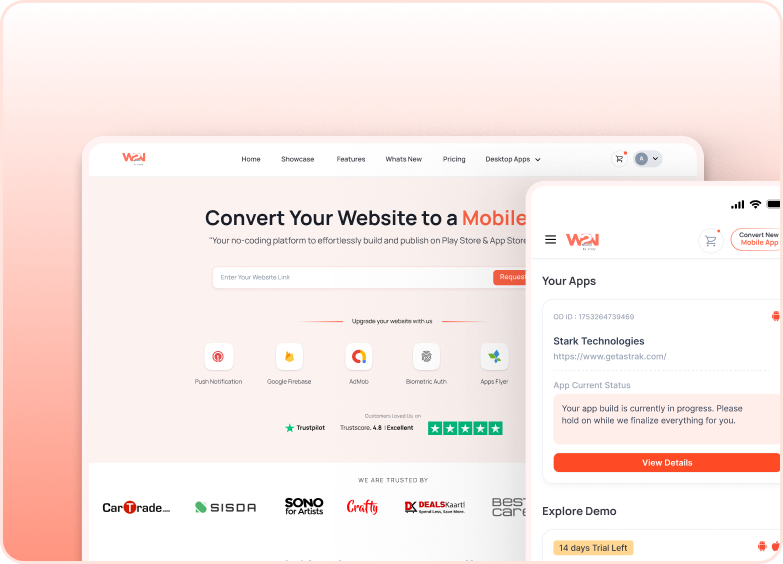


Website to App: When, Why, and How to Switch?
Published on:
8 May, 2026

There was a time when having a website for your business was enough to make you stand out from the crowd. It meant your business was accessible and explorable at all times. The website has become the backbone for many businesses. It was the shopfront, the catalog, and the checkout page all in one browser.
But this scenario is changing rapidly. And if you are still running a website for your business in 2026. It is not enough to grow your business. Whether it is actually delivering the kind of experience that can transform visitors into repeat customers into loyal customers.
Your Website Got You Here. It Won’t Take You Further.
The shift to mobile apps is not coming. It is already here. Nowadays, people shop more on their mobile phones and tablets. According to Oberlo, mobile devices drove $2.51 trillion in sales in 2025, which is more than 21.3% from the previous year. There was a 59% share of total retail e-commerce in 2025, and it is expected to increase in the coming years. The numbers show the behavior change. People first use their mobile devices instead of visiting websites or shops.
Having a mobile-friendly website means you are browser-optimized. In early 2026, people spent less than 6% of their mobile time in browsers and 94% of the total mobile time on app usage. It means your website is competing with 6% of the time people spend in the browsers. The other 94% belongs to mobile apps.
Websites Vs Mobile Apps: breaking down the numbers
According to Criteo, for retail advertisers with both website and mobile app presence, the conversion rate on websites was 4% and on mobile apps 18%. The number highlights that mobile apps have four times higher conversion rates than websites. It is showing the difference between sustaining and scaling the business.
When people spend more time in mobile apps, they explore more products, the experience enhances, and they are more likely to buy. That's why e-commerce mobile app revenue has increased to 36% in 2024 from the previous year. Source
When does the website become a problem?
Imagine a business called Quickit. A hypothetical retail company with five outlets, a strong customer base, and a website managing 200 orders a day. Everything is working smoothly, from generating revenue to website maintenance.
Then the business owner decides to target 500 orders in a day. And the website limitations begin to arise:
| FEATURE | WEBSITES | MOBILE APPS |
|---|---|---|
| Push Notifications | Complex setup and third-party integrations | Built-in and instant |
| In-App Alerts | Limited to the browser | Banners, notification icons, and sounds |
| Checkouts | Re-enter details and payments every time | Save details and order in a few taps |
| Cart Maintenance | Cart items are lost when the browser closes | Cart items are saved every time |
| Payment Gateways | Manually enter card details and limited options | One-tap payment controls |
| Order Tracking | Outdated or no updates on the browser | Real-time updates and location integration |
| Order Status Update | Customers manually refresh the page | Automated alerts are sent after every update |
| Personalized Offers | Backend cookie support required | Based on past orders and user behavior |
| Recommendations | Possible, but requires heavy coding and functionalities | Search history, contextual, and order behaviour |
| Offline Access | No offline access | Access to basic features and their functionalities |
| Re-engagement | Only Emails or SMS | Push notifications, alerts, or icons on the home screen |
| Device Features | No access to device features | Full access to device features |
The website is limited to a few stages of the business. Quickit has reached that stage.
So, when the business owner decides to get an estimate of the investment in mobile apps, including app maintenance, order management, inventory controls, delivery tracking, notifications, and security measures for both platforms, Android and iOS. The number comes to approximately $70,000, adding $2,500 per month for app maintenance costs.
For a business heading to 500 orders in a day, with high conversion rates and a direct communication channel with customers, their app will pay for itself.
The Real Cost of Staying on a Website
Here’s what nobody is telling you about websites. They save money, but you keep losing customers silently. Think about how many people have added products to the cart but left without buying them.
For example, out of every 100 people who add something to their cart on a mobile website, 84% leave without buying. On desktop, the number is 69%. The gap of 15.3% exists for one reason: mobile websites tend to load slowly, making checkout harder and long steps that push the customers away before they pay.
Websites are fighting for attention and engagement in inboxes flooded with emails. According to PushEngage, emails have a click rate of 1 to 2% on average. On the other hand, push notifications have a click rate of 28% SOURCE.
It shows for your retention rates. Every time a buyer searches for your website, they have to find you, navigate between pages, and re-enter the credentials. Mobile app users already receive push notifications on their mobile screens, making it more likely to click on them. Websites fail to give this level of retention.
A website can tell you who has visited and what they have clicked. A mobile app tells you who the person is, what they searched for, how long they were on the app, what they have added to the cart, and when they are most likely to make a purchase—everything from user information to their behavior. This data can be used to convert one-time visitors into buyers through personalizations.
The Signs Your Business Is Ready to Switch
There is no single moment as such for businesses to switch from a website to a mobile app. But there are a few singles that cannot be ignored.
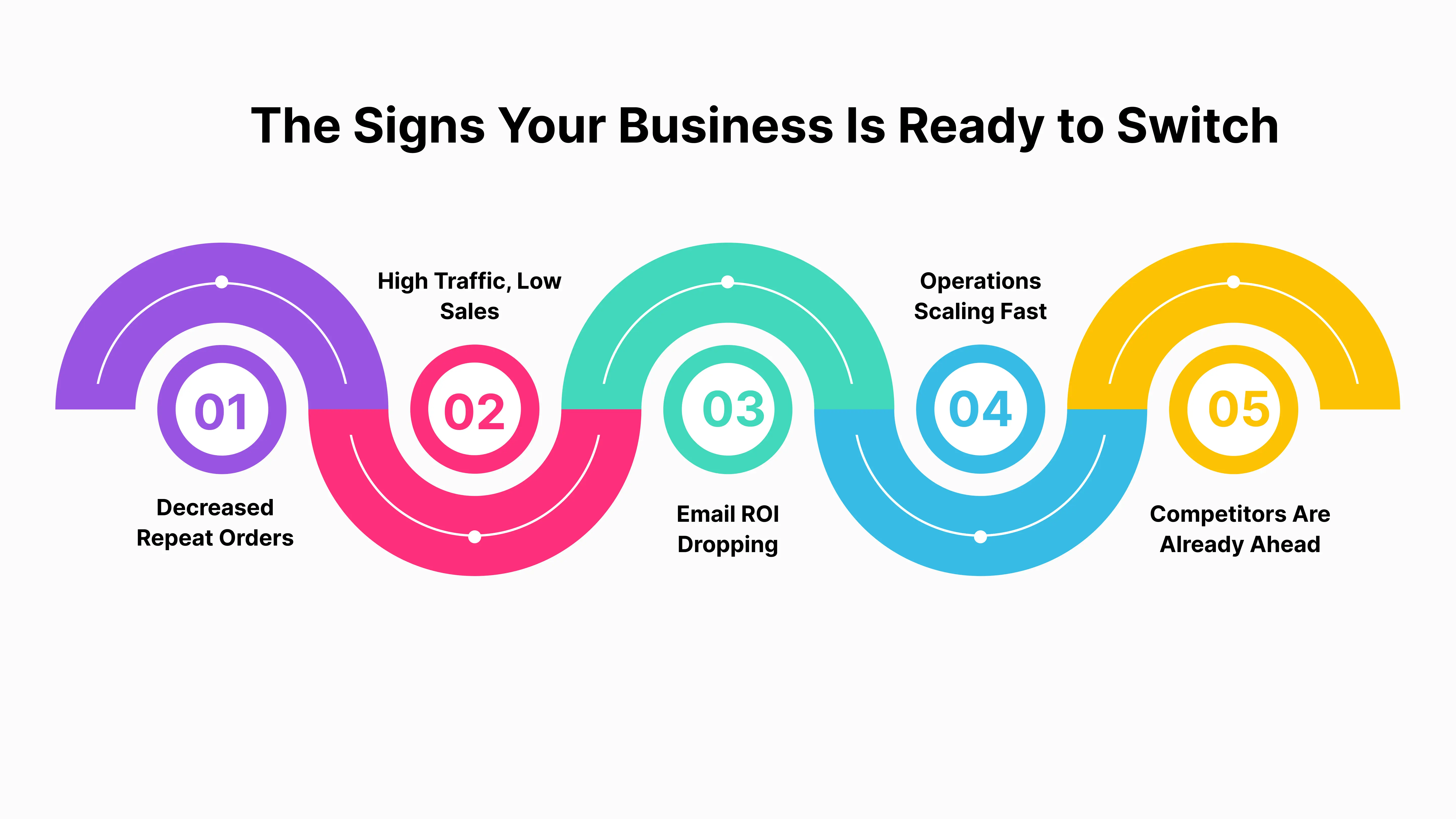
1. Decreased Repeat Orders
If customers are not coming back, there is friction between the website and the buying process. They have to make extra efforts to make a single purchase. Apps reduce this effort as people engage themselves, making it easier to navigate in the mobile app.
2. High Traffic, Low Sales This is the clearest signal for businesses to make a switch from a website to a mobile app. You have increasing website visitors, but they are not transforming into buyers. This means your website is not strong enough to encourage them to make a purchase. Mobile apps are always on the customer’s mobile device, making it more accessible and convenient for them to use.
3. Emails' ROI Dropping
Customers' inboxes are filled with hundreds of emails. As a result, your emails are often ignored or lost between emails, making it harder to re-engage with customers. Mobile apps solve this problem using push notifications, as they work as a direct communication channel between the customer and business.
4. Operations Scaling Fast
Your business is scaling. A website struggles to manage multiple things at once, such as orders, delivery routes, inventory management, and payment success. A mobile app built for future operation management handles the complexity with ease and efficiency.
5. Competitors are Already Ahead
Your competitors already have dedicated mobile apps. When a customer can reorder the same product with just a few clicks but needs to make extra effort navigating to your website, it leads to a clear disadvantage.
The Hidden Gap in Business Growth—How to Fix it
You already have juggled between various blogs and articles about ways to switch from a website to a mobile app. So, now let’s look at that additional way we have added to make this switch easier for your business.
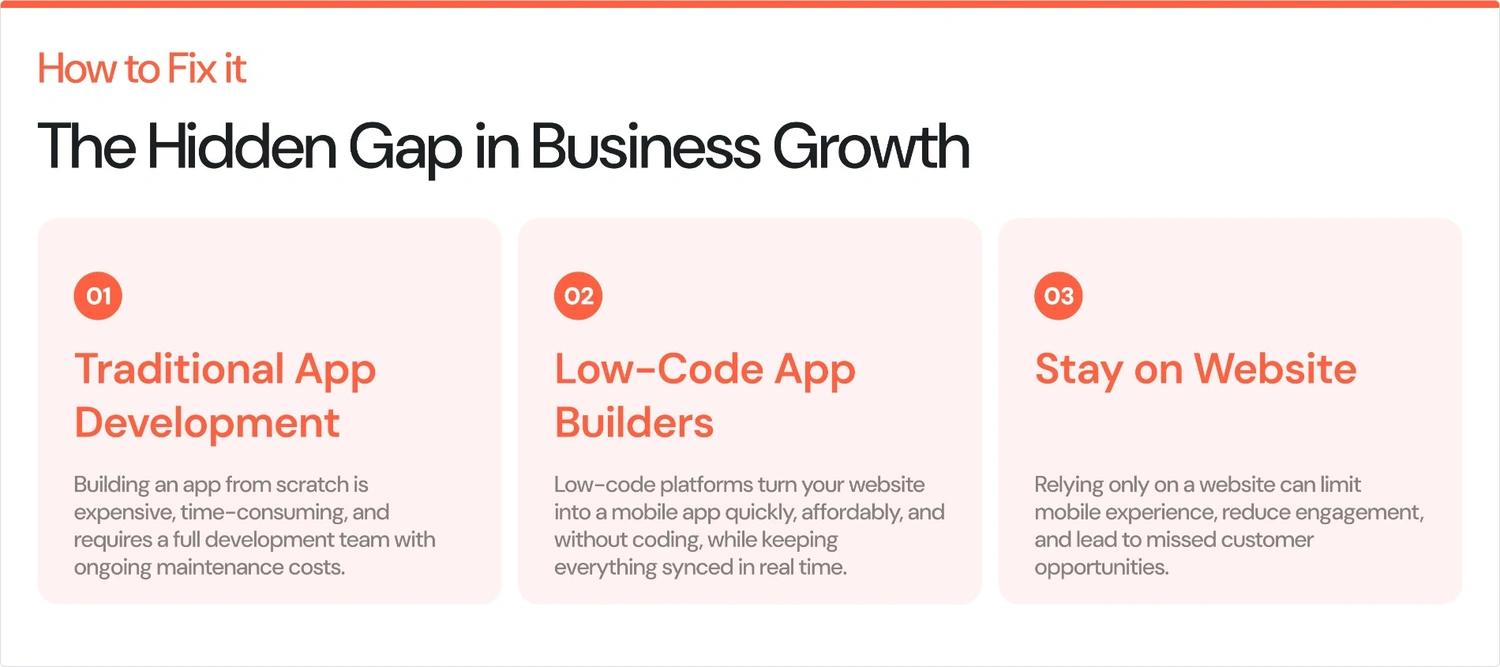
Option 1: Traditional App Development
You can develop an app beginning from scratch, which is effective but highly expensive for businesses. Remember Quickit, where they estimated the cost of a custom-built mobile app ranging from $50,000 to $100,000, plus monthly maintenance and ongoing expenses. It must have a complete team of highly skilled developers with 9+ months of development time.
Option 2: Stay on Your Website
Relying on the website and thinking about the website experience could be good enough in the future. You will revolve around whether it will work in the upcoming months or if the website experience is good and if the website is fully optimized. It will result in losing customers, missing opportunities, and damaging brand credibility.
Option 3: Low-Code App Builders
Neither of the two options will work for businesses having a strong website with a wide audience base but requiring a mobile app without building from scratch and a high budget. Here, Low-code app builders become the best option, balancing both a website and a mobile app. It is a platform that converts your existing website into a fully operational mobile app for Android and iOS without coding and technical expertise. You don’t have to rebuild the app for different platforms. Just build one and publish it anywhere. It wraps your website’s content, features, elements, and buttons inside an app without any extra effort. Your mobile app will be completely synchronized with the website. So, any changes or updates made to the website will be reflected in the mobile app in real-time.
It matters because it holds your website’s audience base and then converts them into buyers through the mobile app. With this no-code app builder platform, you handle both the website and mobile app without any complex development or a higher budget.
For businesses like Quickit, WebToNative can reduce the gap between their growth and development expenses. You will have access to push notifications, geolocation support, social login, multiple payment gateways, access to device features, and more. You have got everything: higher traffic on the website, mobile app engagement, increased conversion rates, and revenue generation.
FAQs
1. Is there a framework for converting a website into an app?
A. Yes, there are many frameworks for website-to-app converters. The best is WebToNative, which converts a website into a mobile app without coding.
2. What is the price difference between website development and no-code development?
A. Basically, mobile apps are expensive to develop as compared to websites. But with the help of no-code or low-code app development platforms, they are more affordable than websites.
3. Can you send push notifications from a website?
A. No, you cannot send push notifications from a website. It requires customer permissions, browser, and device access.
4. What are some tools that convert my website into an app?
A. Some of the tools are WebToNative, Median, Applix, Natively, and AppMySite can convert your website into an app.
The Switch is a Business Decision: Conclusion
According to Mobi Loud’s e-commerce mobile app statistics, mobile apps generate more than 7x revenue per user and contribute 40 to 50% in mobile app sales. So, your website can build a wider audience base, but a mobile app will take you further in generating revenue and increasing customer retention.
Apps are capable of turning a first-time visitor into a repeat customer. It is the direct communication between the customer and your business. In 2026, the question is not about making a switch. The real question is how to make a switch to walk hand in hand with the technology, market trends, and growing customer demands. With WebToNative, it becomes easier for businesses to have worthy websites that can turn this worth into increased revenue.
Your customers are on their mobile phones inside the apps. Your business shows up, and they click. They get engaged, and you get a conversion.
Start Your Conversion Journey with WebToNative.
Similar Blogs