


Why Your Mobile App Is Not Growing in 2026 — Reasons & Fixes
Published on:
2 June, 2026

According to Raas Cloud's 2025 analysis of app usage patterns, 62% of installed mobile apps are unused in any given month, indicating nearly two-thirds of apps on a user's phone never get opened. Not because users have plenty of similar app options, but because the app just didn’t deliver what motivated them to install it. You are not competing to get on a user’s mobile screen. You are competing to be one of the few mobile apps that a user actually opens.
Most app owners think it is marketing, design, or maybe fewer features problems. So they remain focusing on these problems, ignoring the root cause, resulting in the same situation as earlier. The mobile app market has become increasingly selective. Smartphone users are prioritizing quality over quantity, with app stores showing no significant growth in new publications for the second consecutive year. (SOURCE: Statista 2025)
These problems are solvable. But only if you know what needs to be fixed.
This blog breaks down the exact reasons your mobile app is not growing with its realistic solutions.
Ask Yourself 10 Questions If Your Mobile App Is Not Growing
Reason 1: How Can My App Solve the Real Problems of My Customers?
Many mobile apps fail because developers ignore the real problems and market validation, building improper assumptions. They focus on their own goals rather than solving and fulfilling real users' problems.
Business owners, developers, and app builders neglect knowing about what people are actually struggling with, what the current market trends are, and evolving users' requirements. It makes your app look not worthy of downloading or just another mobile app.
Solution
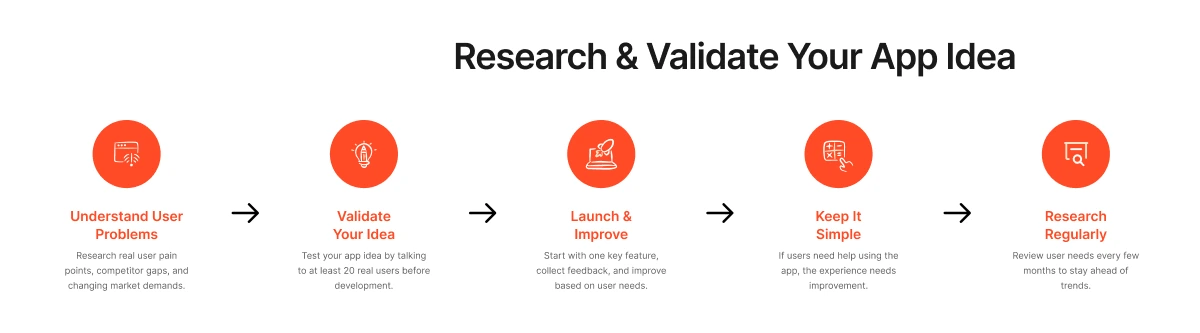
Research on what things real users are struggling with, how often the demands change, what the competitors are ignoring, and what emerging challenges users might face.
The research will help you better understand the problems around which you can build your app that will look like a problem solver to the users. Validate and test your app’s main idea by interviewing at least 20 real users before beginning the app development.
-
Talk to real users before developing the app across platforms like Reddit, community groups, and others.
-
Develop the first key feature and launch it. Gather feedback and add more as per users' requirements.
-
If users require assistance with using your mobile app, the problem is in the app. It indicates the app has failed to deliver its actual benefit.
-
Research your problem every 3 months to stay ahead of evolving user demands.
-
MVP (Minimum Viable Product): An MVP is the simplest version of your app that solves one real problem for particular users. You only develop what is necessary to test your core idea, launch it, and collect feedback before investing more. Apps built without this step solve problems users do not really have. So, Validate First and Develop Second.

Reason 2: How Many Features Should I Include in My App in the Beginning?
Including too many features inside the mobile app backfires on you. It confuses the user and hides the app’s core value & benefit. Including unnecessary features with steps irritates and frustrates users.
It makes them leave the app without even exploring it fully. Each unnecessary feature increases testing time, analytical burden, and maintenance cost, making future improvements slower and more expensive.
Solution
Users only want simplicity inside the mobile app. Launch with essential & necessary features and highlight the app's main benefits and solution. Developers should track users' most-used features, user behaviors inside the app, and their feedback. It is very helpful in developing new features.
-
Develop the first feature that solves a problem and launch it. Everything depends on whether or not the feature has truly resolved the issue.
-
Track features that users use in everyday life. And remove or hide the features that nobody really uses or tailors inside the app.
-
An unstructured mobile app with too many features will only lose users to a great mobile app.
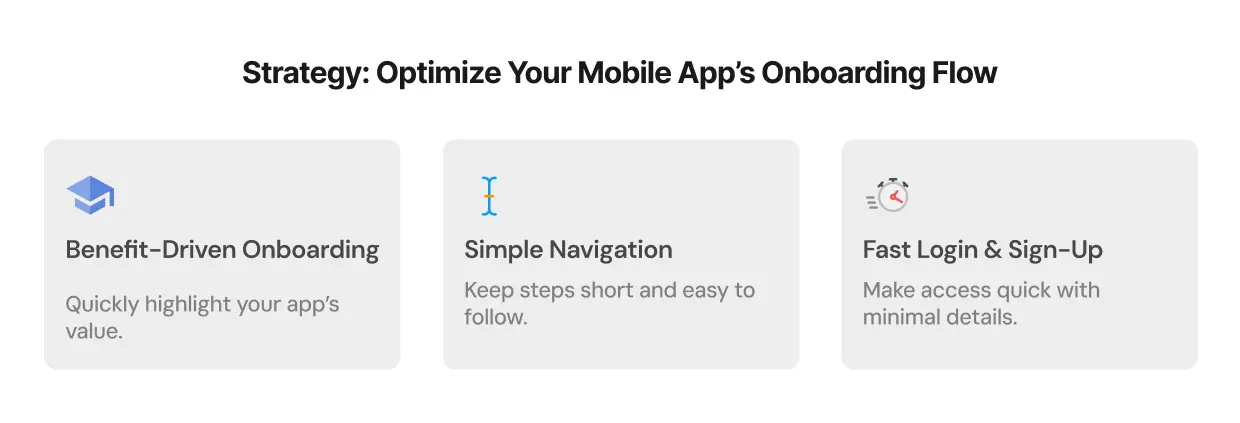
Strategy: Optimize Your Mobile App’s Onboarding Flow
-
Use a benefit-driven onboarding screen to show users what the app can do in a few slides. It instantly communicates the app’s value.
-
Keep the app’s navigation to two to three steps without too much scrolling. People might leave if the steps are too long.
-
Keep login and sign-up simple and fast. Asking for additional information at this moment is the fastest way to lose a new user.
Reason 3: What is the Right Marketing Strategy for My App?
Many people think a good app does not need a perfect marketing strategy. That’s not the real truth. Marketing plays an essential role in making your app reach the target audience and build a strong mobile app presence.
Without a proper promotional strategy, a great app will struggle to get proper traffic, downloads, and attention despite months of hard work.
Solution
Focus on different marketing channels where your target audience actually spends time. It includes promoting your app through different channels or platforms and running campaigns & ads. Marketing strategies help grow your app’s presence and boost your app’s downloads.
-
Select any two of the most popular marketing channels where you have the most targeted audience.
-
Keep in mind that your first 50 to 100 users should reach your app organically without paid marketing.
-
Retargeting users who view your app on the app stores but leave without downloading is one of the growing and underrated approaches.
PRO TIP: App Store ratings directly impact your mobile app download conversion rate. Just like an app with 3.8 stars vs an app with 4.5 stars can double your app downloads. There is a framework called the 40-40-20 Rule developed by Ed Mayer, a marketing expert. It says 40% of your marketing campaign’s success depends on reaching the right audience, 40% on having the right offer, and 20% on the creatives of the campaign. (SOURCE: Dean Mackenzie)
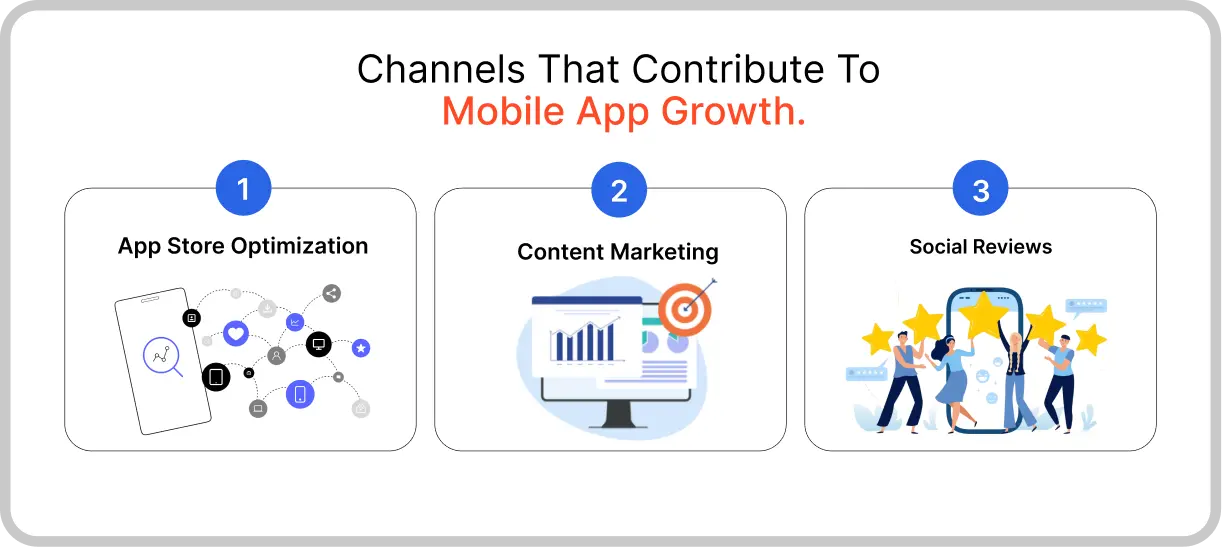
Below are the three channels that contribute to mobile app growth.
1. App Store Optimization
Your mobile apps should be fully optimized with keywords, titles, and screenshots on the Google Play Store or Apple App Store. It works as an ideal marketing approach for your app.
2. Content Marketing
Make content around the problems your mobile app solves. This will make your app a solution-oriented approach for users.
3. Social Reviews
90% of featured apps on both the App Store and Google Play maintained a rating of 4.0 or higher. A one-star rating increase can boost download conversion rates by 10–15%. (SOURCE: Business of Apps)
Reason 4: How Do I Optimize the App Store to Get More Downloads?
Most people discover the apps through the Google Play Store or Apple App Store. The users will never find your app if it is not optimized for the user search query. Once users download the app and do not find it useful, they are more likely to leave or uninstall the app.
According to Harvard Business Review, once a user uninstalls your app, re-engaging them costs 5 times more than keeping a user. The app's first impression in the App Store can push your app to a wider audience.
Solution
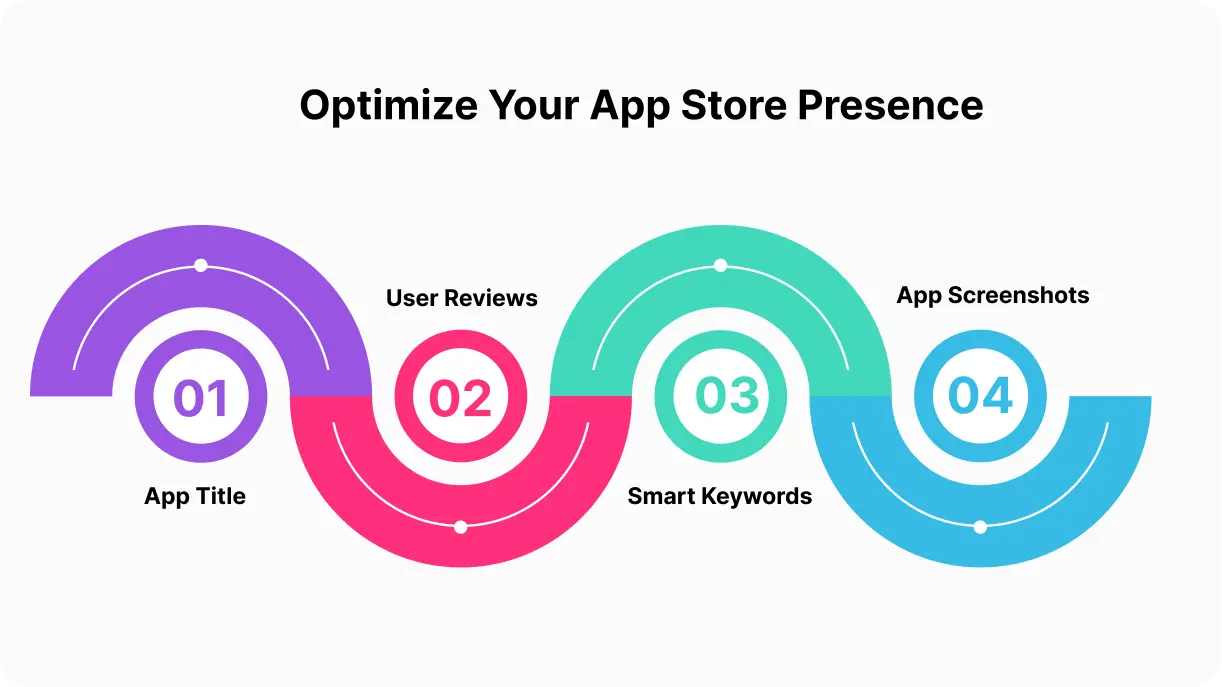
Your app’s profile in the Google Play Store or Apple App Store must be fully SEO-optimized for discoverability. It includes optimizing the app’s title, description, keywords, and screenshots.
Below are a few things to be actually optimized:
-
Title: Include the primary keywords naturally in the app’s title.
-
Reviews: Respond to every review, both positive and negative. It shows that users are being heard by the app owners and developers.
-
Keywords: Research low-competition and high-intent keywords to help in app store rankings. This makes it easier for users to find your mobile app.
-
Screenshots: The first two screenshots help people decide whether to download it or not.
This requires consistent app updates based on keyword trends, evolving market changes, and user search behavior to maintain a powerful and reliable presence among the platforms.
-
App Store Optimization is not a one-time task. You must review the keywords every 30 days for emerging trends.
-
Your app’s icon is the first impression users view in app store search results. Test across versions and devices.
-
A four-word app’s title, including a keyword, naturally has better performance.
-
Localizing your app store listing across different regions might increase your organic search.
Reason 5: How to Choose the Best App Monetization Strategy?
Many apps launch without prior information about how they will generate revenue. Developers only focus on downloads and assume growth as the downloads increase. Neglecting real expenses, such as development, maintenance, and marketing costs. Without an ideal monetization strategy, an app struggles to survive financially from the beginning.
Solution
You must have a monetization strategy that perfectly fits your mobile app, such as a subscription, in-app purchases, or premium features. Validate the prices thoroughly with real users through A/B testing on your payment wall.
It is essential to track revenue and cost from the beginning, not only to depend on downloads. This is required to have multiple revenue sources, which will help the app be financially stable in the long term.
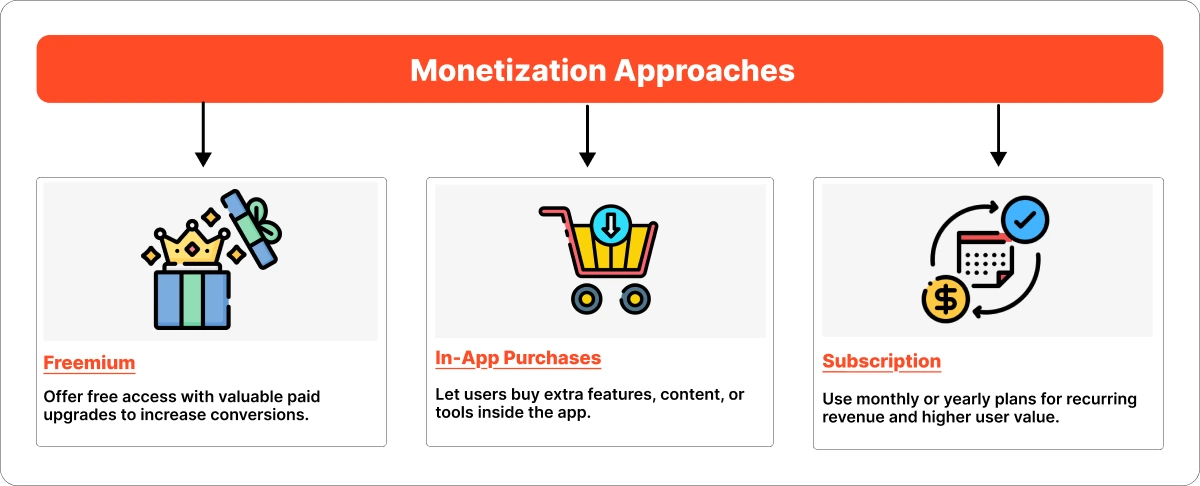
Below are three monetization approaches that really work
1. Freemium
Download for free with paid upgrades. It is best suited for apps with a wider potential audience. Ensure that your paid upgrades are powerful enough to convert a freemium user.
2. In-App Purchases
Users purchase specific elements & components inside the app. It is ideal for designing, education, games, and content-driven mobile apps. This type of purchase feels more like a reward than a liability.
3. Subscription
Regular monthly or yearly subscription. It is perfect for mobile apps offering fitness, workshops, finance, or productivity. This approach delivers one of the highest lifetime values per user when implemented properly.
Key Points
-
You should never launch the app without having a monetization approach. Introducing it later might confuse the existing users.
-
Apps with subscriptions retain users longer as paid plans keep them engaged.
-
Your app’s free tier should be valuable enough to attract users, but limited enough to make them upgrade.
Reason 6: How Do I Retain My Customers Once They Download My App?
Revenue does not increase when users download the app. It increases as the app grows and users come back again and again. An app without personalization, retention, and engagement strategies causes users to lose interest in their apps fast, destroying revenue and churn rates.
Solution
An app with higher retention and engagement rates delivers value instantly. You must track user behaviors and rates regularly to make strategies and grow your app. The app should offer loyalty programs, personalized notifications, in-app rewards, and discounts to keep users coming back.
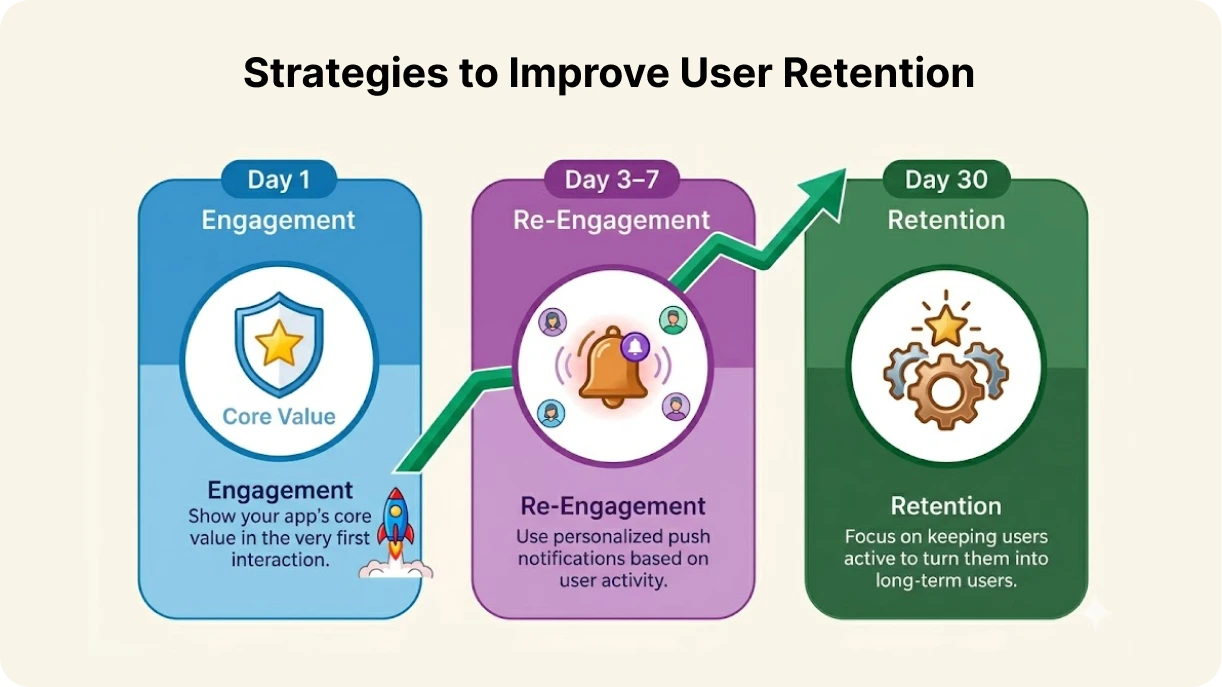
Retention is a trackable flow like the following:
Day 1: Deliver your app’s core value within the first interaction. It is decision-making time for the user to download the app or not.
Day 3-7: Push notifications based on the user’s behavior and activity.
Day 30: Users who reach Day 30 are more likely to become long-term users. Focus on each retention to reach this period and spend more time inside the app.
-
The ideal retention strategy is the app that solves the problem better every time.
-
Push notifications sent at the wrong time make the users ignore you.
-
In-app rewards make users feel rewarded for their loyalty to the mobile app.
-
Track your Day 1, Day 7, and Day 30 retention, as each point has a different fix.
Strategies to Boost Customer Retention
1. Use Push Notifications
-
Personalize push notifications based on the user’s app behavior. A relevant and behavior-driven notification feels helpful and generic at the same time.
-
Keep mindful of the time zones when scheduling notifications. But sending a message at the wrong time can push users to disable notifications completely.
-
Find the right frequency before sending notifications. If they disable this, they might forget about your app’s presence.
2. Use Gamification
Integrate game-driven features such as referrals and loyalty programs. This encourages users to take actions inside your app. Mobile apps with this kind of interaction keep users engaged in the app.
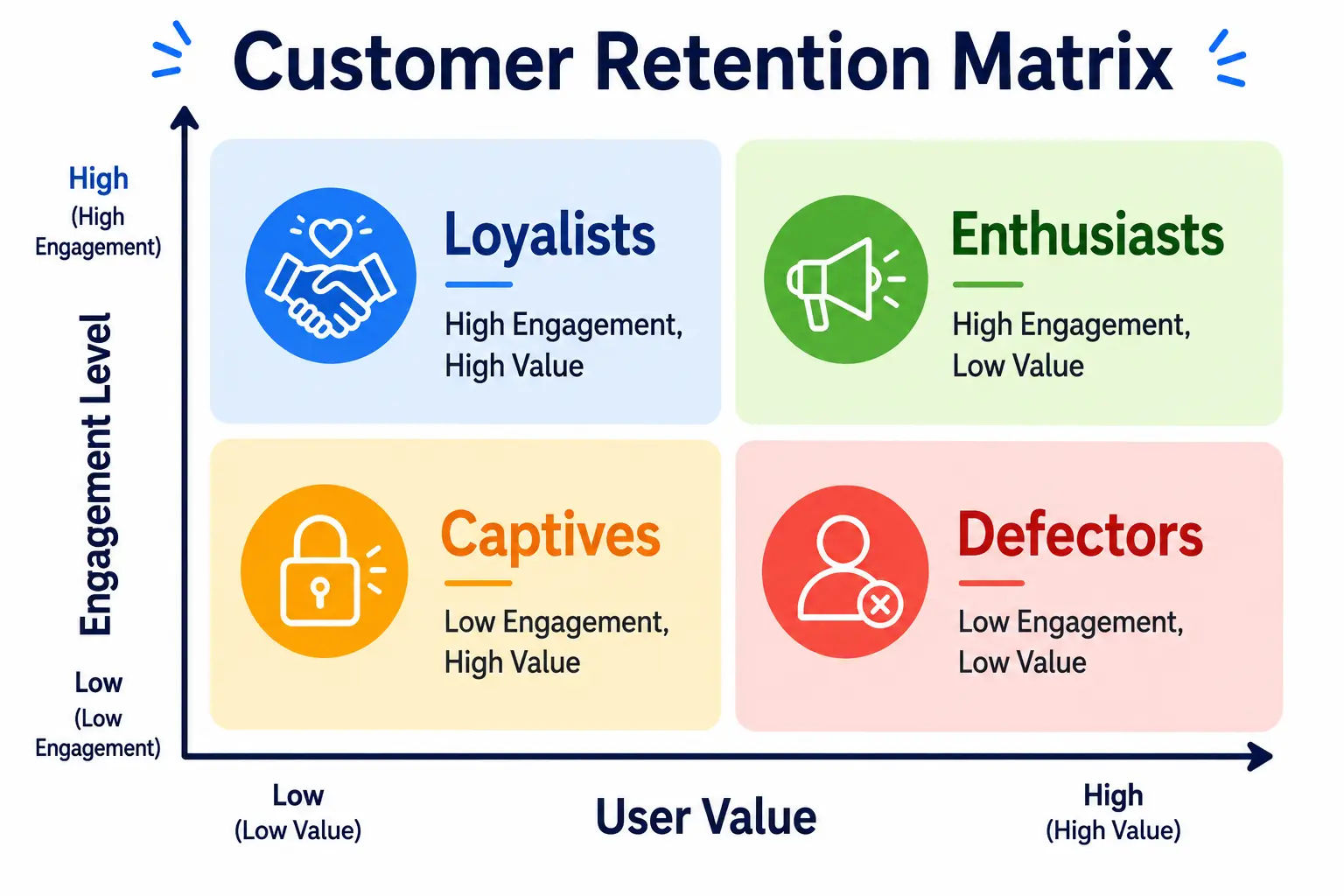
3. Customer Retention Matrix
Use this to segment users by engagement and value to target each user differently. Formula Retention Rate = (Users at End of Period − New Users Acquired) / Users at Start of Period × 100. Track the metric every month to detect if there is any dropping retention to turn users before they leave completely. (Source: Net Suite)
Reason 7: How Often Should You Update Your App?
Launching your app does not mean that your work is done. Updating your app is essential to ensure that users have a bug-free environment and can navigate the new features smoothly. When the app stops improving, users slowly lose interest, leading to low interaction and uninstalls. Once the user loses interest, winning them back costs even more than keeping them engaged inside the app.
Solution
Your app is a living product, not a one-time project. Release updates, fix reported bugs, and introduce new features as per users’ feedback, making them feel valued and listened to. A frequent updates history with new releases indicates that you are working on and maintaining the app’s core functionality. It helps build credibility for both users and platforms that the app is genuinely improving without being abandoned.
-
Your app update history is public on the App Store. A few users view this before downloading the app. Only bug fixes can make updates seem unimportant.
-
Set up a simple feedback form inside your app. Users who report issues are your most valuable testers and loyal users.
-
Send a push notification when a new version or feature drops, keeping users informed.
-
Track your app store ratings before and after each update.
-
20-40 days is the perfect spot for app updates. Anything less is bad for your dev cycle. “Anything longer than that signals to users and app stores that the app is not being actively maintained. (Source: Coderio)
Strategy: Constant Development and Optimization
-
Always track user behavior and gather feedback before making updates, ignoring what users actually need.
-
Track competitors to see what they offer and how they offer it.
-
Regularly update your app with user-centric features and fresh content to make users keep coming back.
Reason 8: How To Design A Better Mobile Checkout Process
When revenue drops, most app owners start adding new features or redesigning the user interface. But neither of these fixes the real problem. The real problem is almost the payment flow.
The growth only depends upon two things: how many users reached the final payment page and how often people made purchases upon reaching the payment page. If users rarely reach your payment wall, then the chances are very low of making a purchase. It results in low revenue generation, no matter how perfect your app is.
Solution
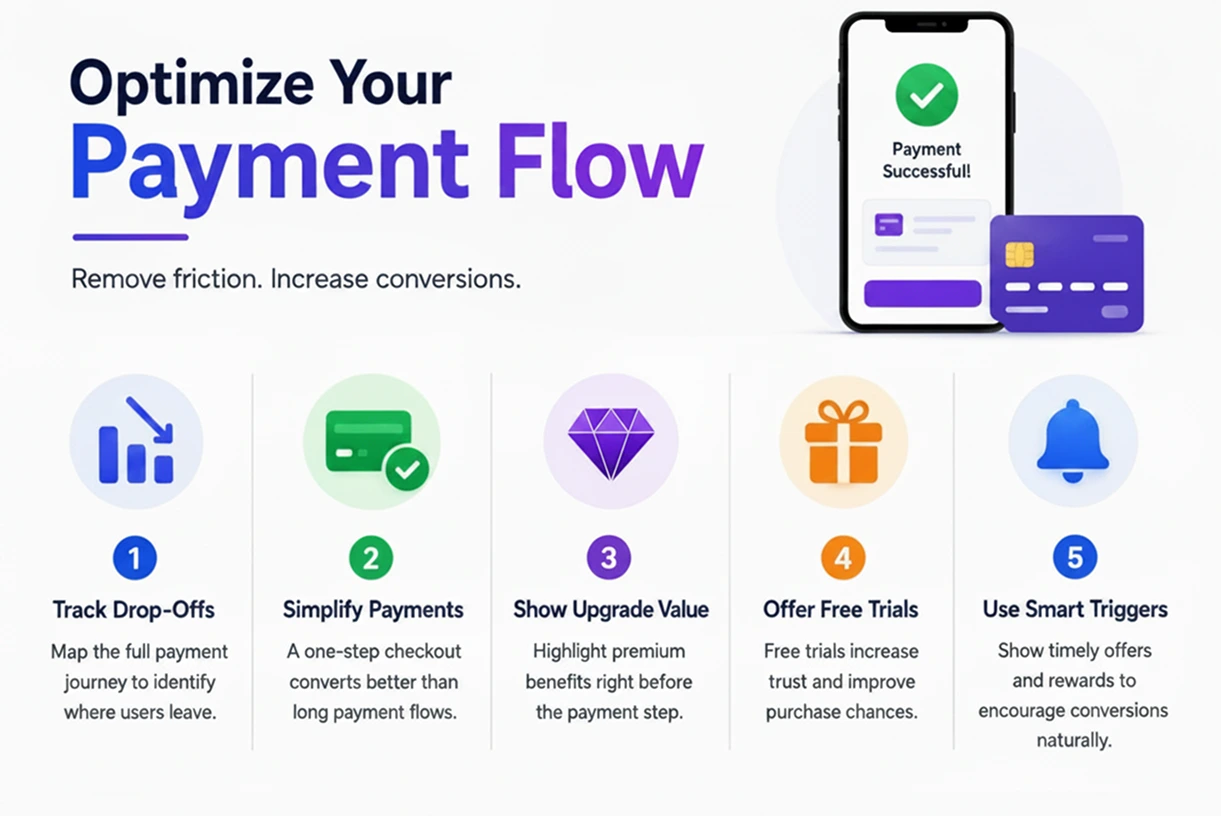
Before focusing on adding new features and changing the UI, you must fix the payment flow. You should track the user activities and gather feedback to know the real cause of the problem.
-
Map your complete user payment flow from app installation to purchase. It will help you track exactly where users leave.
-
A one-step payment process always converts better than a four-step payment process.
-
Show the result of upgrading the app right before the payment flow.
-
You can offer a free trial instead of asking for payment right away. It is believed that users who try the free trial are more likely to make a purchase. (SOURCE: Stripe)
Test different ways and triggers to encourage them to purchase without forcing them. Show the right offers or rewards at the right time, with a few steps to the payment page to help move the revenue generation forward. It is a slow process but highly impactful.
Ask Yourself Only These Two Questions
Q1. How many users are actually reaching your payment page?
If a few active users reach the payment page, no amount of features will fix your revenue. The problem is the funnel, not the product.
Q2. Of the users who reach the payment page, how many actually buy?
If users are left on the payment page, then either your payment flow or interface must be fixed. Fix the funnel → Fix the conversion → Features last.
Reason 9: How to Increase Your App’s Speed and Performance?
Many apps struggle because they were launched too quickly and developed without thinking about long-term scalability. The result is a complex codebase, slow performance, frequent crashes, maintenance costs, and improper structure. It directly affects user experience, the app’s revenue generation, and retention rate.
Solution
Many successful apps are developed with a scalable structure to improve based on user feedback in real-time. Developers focus on agile development cycles with frequent optimizations inside the app, making it clean and maintained. It results in consistently good app performance without increasing budgets on unnecessary rebuilds or bugs.
-
Speed is a feature. Your loading time should be worth fixing.
-
Test and review your mobile app across devices thoroughly.
-
Track your app store ratings weekly. A sudden drop will help you fix the gap before increasing it.
Three Signs Your App’s Technical Setup is Slowing the App's Growth:
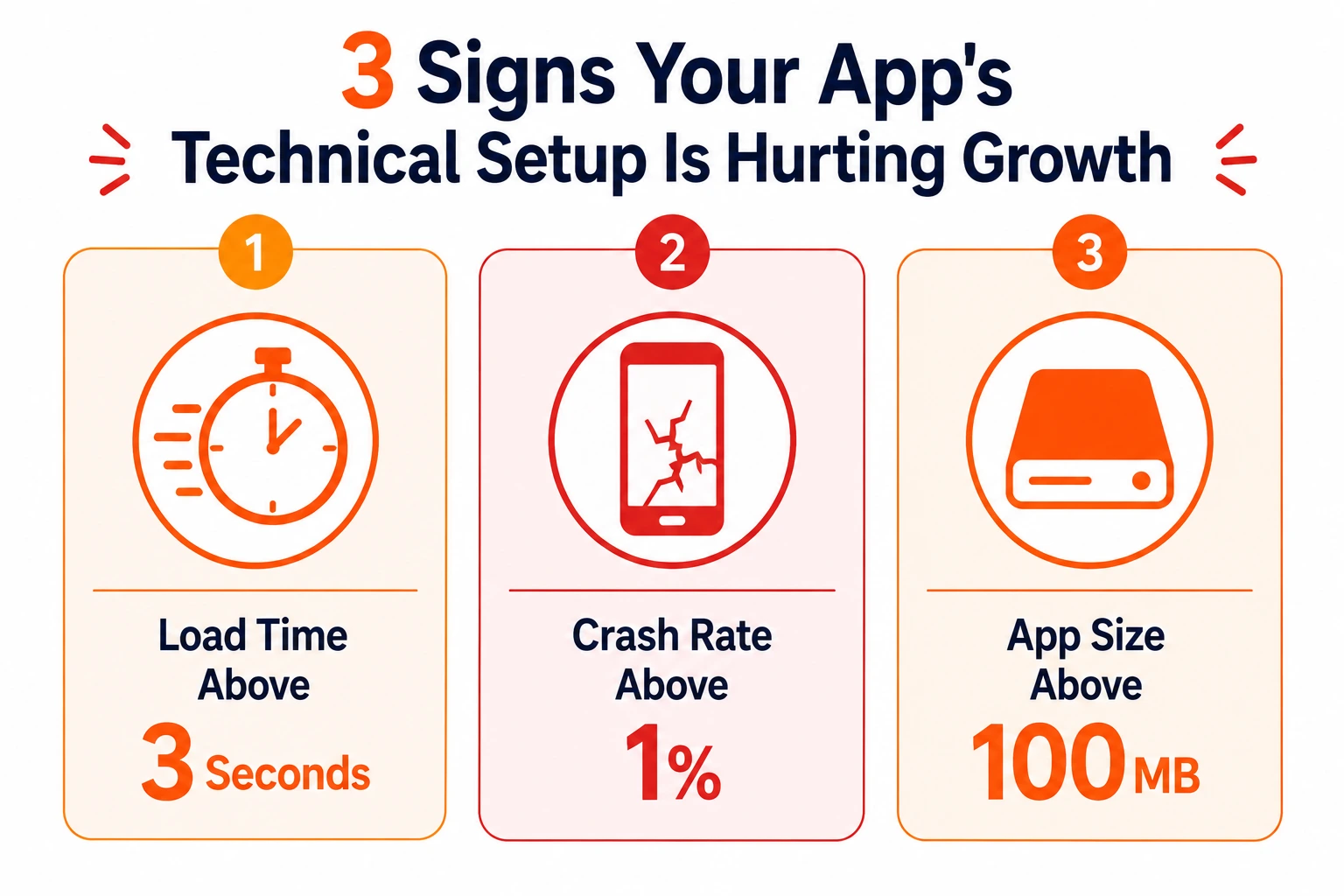
1. Load Times below 2 Seconds
If your app takes too long to load, users will either leave or find another mobile app. Keep the startup time under two seconds. And optimize your app to avoid unnecessary battery and memory drain. (Source: Code with Chris)
2. Crash Rate Above 1%
App stores track your crash rate. A higher crash rate directly lowers your search rankings.
3. App Size Above 100MB
Your app’s large size reduces installs in low or no-internet connections and on limited storage devices.
Strategy: Track User Data from the Beginning
-
Use cohort analysis to group users based on their behavior and track how each user group behaves over time.
-
Use heatmaps to visualize exactly where users click, scroll, and leave.
-
Set up crash monitoring from Day 1 so that you can quickly fix issues before users uninstall your app.
Reason 10: How Can I integrate the payment systems into My App?
Apple has forced each app on the Apple App Store to use its own in-app payment system. App owners must accept it. That has changed in 2025. The Epic Vs Apple Ruling opened the door for app developers to direct users to external payment options. It means you can offer your own checkout and pricing. This is the most unused competitive advantage sitting on the plate, which is ignored by most app owners.
Solution
Review your existing payment process. If you are still routing transactions through Apple’s in-app purchases without testing alternatives. It leads to a decrease in revenue for each transaction.
What You Can Do Right Now:
-
Add an external payment link or checkout option to your app to reduce platform fees and keep more revenue for users.
-
Test both in-app and external payment options with different user groups to understand which checkout options deliver effective conversations and long-term retention.
-
Ensure your payment setup follows regional policies and platform rules for a smooth flow.
Key Points
-
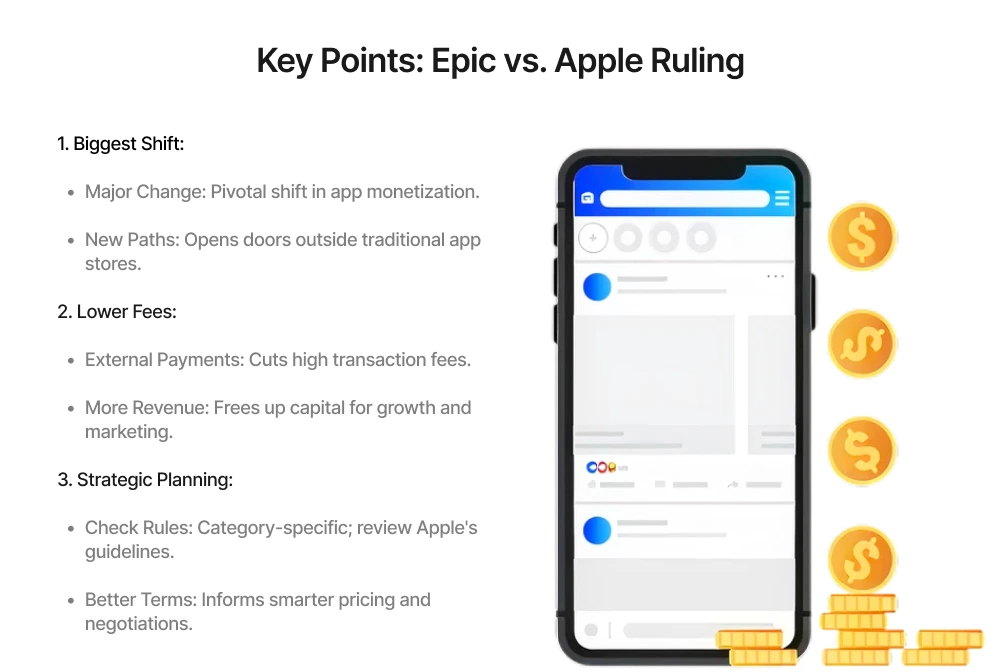
The Epic Vs Apple ruling is the biggest shift in mobile app monetization approach.
-
External payment gateways mean lower transaction fees. That means more revenue for growth and marketing.
-
Not every app category is affected. You must look for Apple’s current guidelines for your specific app type.
-
Proper understanding of the ruling helps you plan effective pricing and negotiate better terms.
FAQs
Q1. Why is my mobile app not getting installs?
A. Many mobile apps don’t get expected installs because they are not visible in the App Store. Your app’s visibility depends totally upon how perfectly your title, description, keywords, and screenshots are optimized to find the app on the Apple App Store. According to Branch, around 40% of mobile apps are discovered directly through the Play Store or App Store. So, a poor optimization is the first thing you must fix.
Q2. How long does it take for a mobile app to grow?
A. There is no proper time period to grow a mobile app. The apps must be consistent in delivering good app performance, value to users, regular updates to app cycles, a proper retention strategy, and a revenue generation model. You must track your app’s behavior and performance with users’ feedback and behavior to remain uniform in growing your app.
Q3. Why do users uninstall my mobile app frequently?
A. The most common reasons that lead to instant app uninstalls are slow loading speed, improper navigation, cluttered UI, and app crashes. Most mobile apps fail to deliver value within their first interactions, leading to users leaving the app and never coming back.
Q4. Why is my mobile app not generating revenue even with good downloads?
A. Most app owners assume their app is not generating revenue because it does not have enough features or has an outdated UI. Revenue generation has only two questions: What do users do when they reach the final payment page, and how many users actually make the purchase. Answers to these two questions will solve this problem if tailored correctly.
Q5. What is a good retention rate for a mobile app?
A. Day-30 retention varies significantly by category. Games and utility apps average 3–8%, while social and finance apps reach 10–18%. If your app is above the average for its category, your retention strategy is working. The overall cross-category average sits around 5%, but comparing your app to this single number is misleading without knowing your category benchmark.
Q6. If I spend more on marketing my mobile app, can I fix low app growth?
A. Not always. Many mobile apps struggle to grow even when spending on marketing. This is due to the app not fulfilling the user’s expectations and current market trends. If your mobile app is not solving a real issue, the marketing spend will only accelerate. You must fix the mobile app with proper retention and then plan a marketing strategy for scaling.
Q7. Can a mobile app grow without paid advertising and marketing?
A. Yes, organic reach through strong app store optimization, word-of-mouth, content marketing, and loyalty programs that help drive sustainable growth without the need for paid advertising and marketing. Organic installs tend to leave a long-lasting impression with higher user intent. They found you because they were actually looking for what you are offering.
Q8. How important is App Store Optimization for mobile apps to grow?
A. Many mobile apps are discovered through Play Store or App Store searches. ASO is not about ranking. It affects the mobile app’s conversion rate, credibility, and how many people actually download after finding your mobile app.
Conclusion
Growing a mobile app is not a one-time deal. It requires consistent maintenance and effort to keep the mobile app alive. It breaks down to genuinely solving a real-user problem, having a perfect monetization strategy, and making users keep coming back. The mobile apps with complex codebases and highly engaging UI do not grow as compared to an app with the right problem-solving strategy and fundamentals.
If your mobile app is not growing, something broken needs to be fixed. And now you know exactly where to find it.
Similar Blogs