


Websites Vs Mobile Apps: What works for YOU?
Published on:
6 May, 2026

Think about the last time you actually opened the web browser to search for something. I bet you don't even remember. Whether it was doomscrolling, ordering food at night, editing videos, or watching tutorials, you did all these through apps without even thinking about the websites. Mobile apps are woven into our daily lives.
According to Adjust, the installation of e-commerce mobile apps has increased to 55% in 2024.
So what makes the mobile apps addictive as compared to websites?
Let's Start...
What is a website?
A website is a group of interconnected web pages that are publicly accessible, such as text, images, and videos. It shares the same domain and is hosted on a web server. The web pages of the website are connected with hyperlinks and hypertext with a common interface and design. Websites are accessed through different web browsers such as Chrome, Microsoft Edge, Safari, and more.
What is a mobile app?
A mobile app is a software application that is designed to run on mobile devices, tablets, smartphones, and other handheld devices. It provides a more personalized experience than websites. Apps have wider functionality, such as GPS location, biometric authentication, notifications, and more. Apps are divided into three categories: native, hybrid, and web apps.
Websites Vs Mobile Apps: What is the difference?
For example, a website is a mall anyone can come to without any effort, but a mobile app is personal and built for people who want to stay connected with you.
| FEATURE | MOBILE APP | WEBSITE |
|---|---|---|
| How to Access | Download or install the app from the Play Store or App Store | Enter the URL or search in the web browser |
| Speed | Loads faster and instantly as you open the app | It takes time to load all the elements from the server |
| Offline Accessibility | Few features are accessible with a low or no internet connection | They work on the internet connection only |
| User Experience | Designed to engage users with an intuitive interface | Smooth on desktop, but difficult to manage on mobile |
| Push Notifications | Send notifications, alerts, updates, and reminders anytime | Cannot send or push notifications |
| Device Features | Device features such as camera, fingerprint, and more make it more reliable | Limited features inside a web browser |
| Login and Memory | Log in only once after the app is installed, storing all your data and history | Log in again and again as many times as you access the website |
| User Retention | View the app multiple times as they spend most of their time on the mobile | Likely to forget the name of the website because of low browser usage |
| Conversion Rate | More likely to purchase or take actions as the user interacts repeatedly | Friction between website pages due to slow loading time |
The difference clearly states how mobile apps have a broader engagement for businesses that require real-time user interaction. It ensures the users keep coming back to their mobile app and spend time on it.
Customer Journey: Websites Vs Mobile Apps
It is important to understand the user behavior on websites and mobile apps. According to AdRoll, mobile apps have a 157% higher conversion rate than websites. Basically, users spend more time inside mobile apps than on websites.
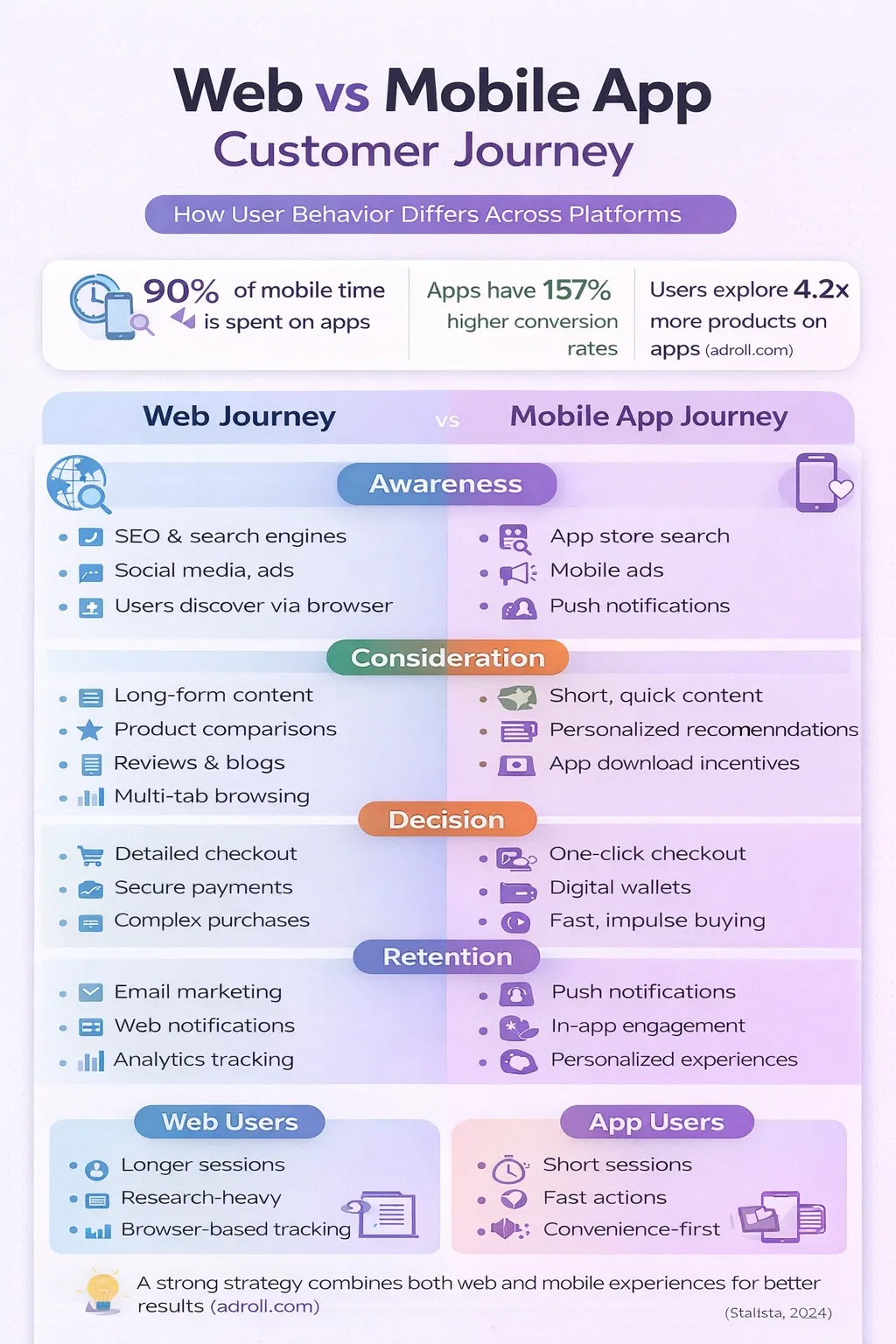
Let’s see the difference in users on each stage of the customer journey.
Stage 1: Awareness
On a website, users find you through Google Ads, browsing other websites, and search engines.
On mobile apps, users find them through the Play Store or Apple App Store and social media.
Stage 2: Consideration
Website users demand more features, personalized preferences, and more detailed information.
Mobile apps deliver full-fledged functionality with user control over features. It provides personalized recommendations without losing user preferences.
Stage 3: Decision
Users on websites often leave if the purchasing steps and checkout pages feel complex.
**Mobile apps ** use one-click payments and digitized payments, making it faster for users to make a purchase.
Stage 4: Retention
Websites depend on emails to bring the users back. It has lower retention rates than mobile apps.
Mobile apps use push notifications and alerts for instant engagement without forcing.
The bottom line is that website users juggle between tabs, repetitively setting preferences. But mobile apps are faster, instant-action driven, and convenient for users to access anytime.
Which is right for your business in 2026 – a mobile app or a website?
According to Backlinko, people spend an average of 5 hours and 16 minutes on their mobile devices every day. The number speaks for itself about how strong the presence of the mobile apps is.
Mobile apps tend to load faster than websites as elements, images, and user interfaces are stored on the device. It delivers an instant and responsive view of the mobile app.
The website doesn’t remember you or your preferences, but mobile apps do. An app stores every action and detail about you. So, they allow you to start where you leave. On the website, you have to start again from the beginning, making users frustrated.
With mobile apps, businesses live on users' home screens and maintain consistent visibility without forcing. It reduces the manual effort of opening the web browser and typing the URL. This small convenience impacts user interactions with mobile apps.
When a user installs a mobile app, it acts alone as a powerful brand visibility tool. People depend more on apps, as they become habitual, instead of websites. Individuals often trust apps when making payments or sharing personal information.
Mobile apps are designed to deliver a personalized user experience. As it focuses on becoming a part of their daily life.
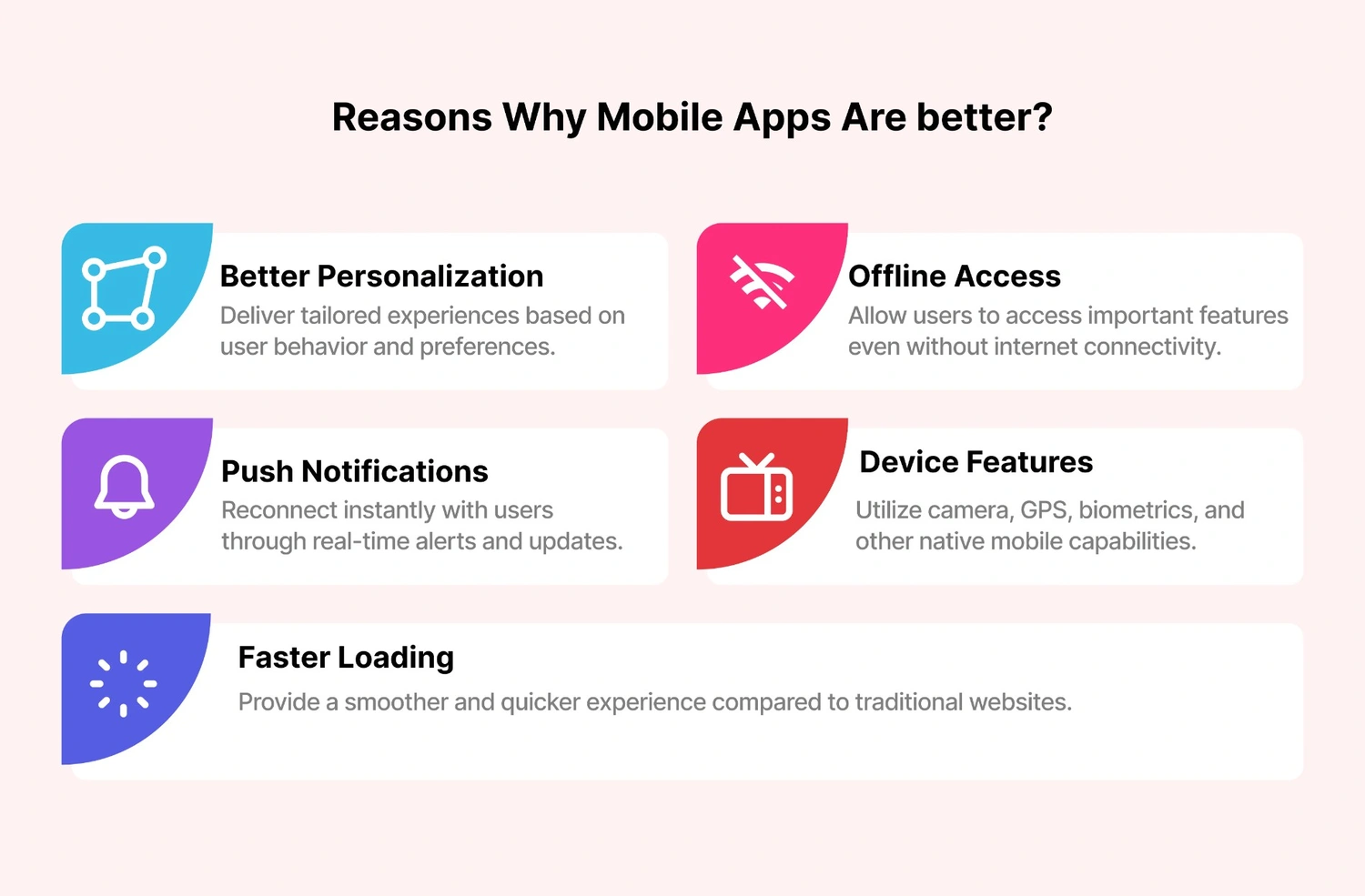
5 Reasons Why Mobile Apps Are better?
1. Better Personalization
Apps track user preferences and behavior in real-time to provide tailored recommendations and results to each user. Websites cannot match this personalization, as when you close the tab or website, all your preferences are lost.
2. Push Notifications
It is the most common reason businesses switch to mobile apps. Users have hundreds of emails a day, requiring manual effort to open each email and view its context. While mobile notifications are highly engaging, clickable, and accessible instantly, resulting in higher engagement rates and traffic.
3. Offline Access
Websites require an uninterrupted internet connection to function properly. But mobile apps deliver basic functionality in case of no or low internet. It includes a calculator and games, keeping users engaged.
4. Device Features
Mobile apps are beneficial for businesses and more advantageous when you have full access to all the device features, making the user experience more efficient and reducing repetitive task effort. On the other hand, websites have limited features with limited functionality, making users irritated and frustrated.
5. Faster Loading
Mobile apps locally store data on the devices, making it faster to load than websites. When users get quick responses, it increases the app's conversion rates and user experience.
WebToNative - Best solution to convert your website into an app
As discussed above, it is clear that mobile apps are becoming the center of interaction for users with your business. The question is how to get one without spending months or higher development costs on building a mobile app from the beginning.
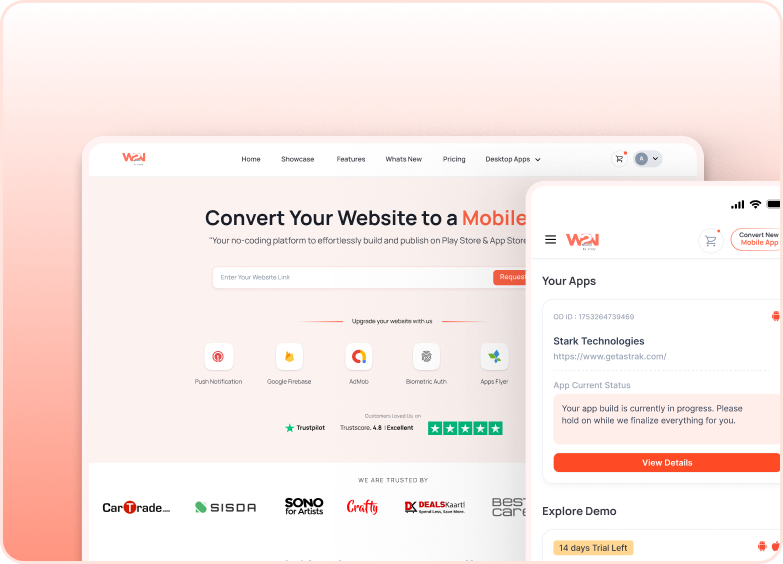
This is exactly where WebToNative comes in as a savior for your business. You can transform your existing website into a fully functional mobile app for Android and iOS without developers and coding. It will wrap your website into a mobile app with essential features. The platform streamlines the conversion process, offering proper guidance and easy-to-follow steps, which makes it both budget-friendly and accessible for each user.
FAQs
Q1. Which drives more conversions, mobile apps or websites?
A. Mobile apps tend to drive more conversions than websites. People rely on mobile apps more while making payments or sharing personal information.
Q2. Mobile apps or websites, which engage or attract users more?
A. Mobile apps engage and attract users more than websites. Mobile apps store user behavior, their preferences, making it easier for people to engage with the app.
Q3. Coding or technical knowledge needed to convert a website into an app with WebToNative?
A. No, WebToNative is a no-code and low-code app development platform that converts a website into an app without prior coding and technical knowledge.
Q4. Is mobile app development expensive?
A. Yes, mobile app development is more expensive than website development. However, low-code platforms are the solution for this problem.
Q5. Can I build a mobile app without coding?
A. Yes, many low-code and no-code app development platforms require less or no coding to build a mobile app, for example, WebToNative.
Q6. Are mobile apps faster than websites?
A. Yes, mobile apps load faster and are more responsive than websites. Apps store data locally on the device and fetch new data from the server. Whereas websites take time to completely load all the elements, contents, and scripts every time.
Conclusion
Mobile apps are the backbone of the business, as they encourage users to come again and again, increasing retention rate and traffic. Websites limit users from taking actions and accessing features offline. Apps work as reminders to users for interaction on a daily basis without being forced. A single tap and the user is inside the app.
One of the best platforms contributing to the development of mobile apps is WebToNative. A no-code app converter for business is becoming a simplified and efficient choice.
Similar Blogs