


Emergent & WebToNative -- What I Learned After Actually Using Both
Published on:
14 August, 2026

So you have a website already running in the browser or maybe an idea for one, and now you are trying to figure out the fastest way to turn it into a real working app. Somewhere in that search, you have come across two platforms like Emergent and WebToNative. Users see these same searches and assume they solve the same problem.
As a developer, I actually used Emergent by writing the prompts, building, testing, and adding new features. I was curious to know what the hype was really about instead of relying on others' reviews.
This blog follows what I found, what they cost, what the two platforms are, and a comprehensive features comparison.
What Is Emergent?
Emergent is an AI-powered app builder platform that allows users to build, test, and deploy full-stack applications using normal and conversational language prompts. It is the world’s first agent-vibe coding platform that takes users from prompting to production-ready applications in an hour.
The platform handles frontend, backend, authentication, and deployment. Emergent helps non-coders, developers, individual founders, and product managers to launch their applications faster than ever. GitHub integrations, live preview, deployment, and testing make the process even easier. For mobile applications, it generates the app in Expo and React Native code. For website applications, it generates the app as React and Next JS.
| Founded In | 2024 |
| Founded By | Mukund and Madhav Jha |
| Headquaters | San Francisco |
| Apps Built | 6.5M+ |
| Trustpilot Rating | 3.0 |
| Team Size | 50 to 100 Employees |
What Is WebToNative?
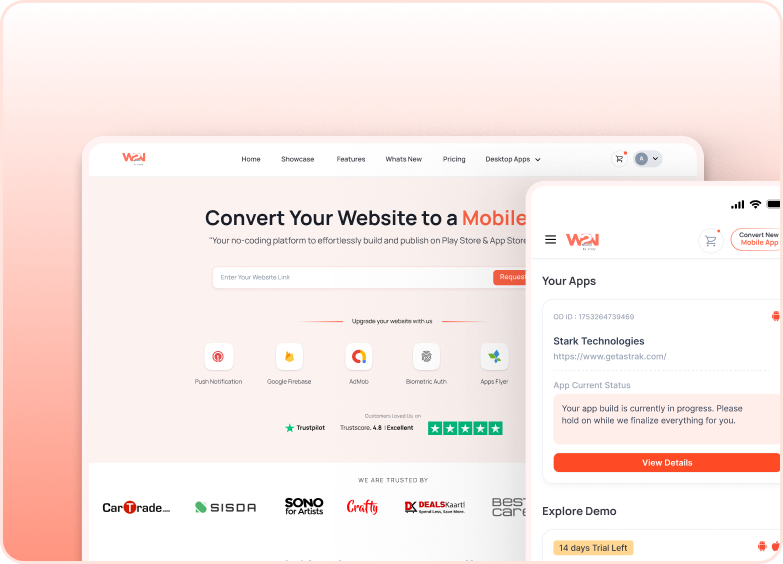
WebToNative is a no-code and low-code mobile app builder that converts websites into Android, iOS, and Desktop apps. There is no new codebase without any prompt loop. Every change on your website automatically reflects in your mobile app in real-time. Instead of building an app from scratch, the platform wraps your existing website inside a native shell.
It offers essential native features such as push notifications, splash screen customization, deep linking, custom user agents, geolocation support, camera access, offline functionality, and more for deeper native functionality. WebToNative handles the end-to-end publishing process for both Android and iOS applications, along with Samsung Galaxy Store, Amazon App Store, HUAWEI, and Xiaomi publishing services.
| Founded In | 2019 |
| Founded By | Vikash Sharma and Venkatesh Mohta |
| Headquaters | Jaipur, Rajasthan |
| Mobile Apps Built | 400K+ |
| Trustpilot Rating | 4.7 |
| Team Size | 11 to 50 Employees |
The Ultimate FEATURE Comparison
The two platforms solve different problems. Here is the comprehensive breakdown of features.
| FEATURE | Webtonative | Emergent |
|---|---|---|
| Converts an existing website into an app | Yes | Not the product model |
| Builds an app from scratch via AI prompts | Not the product model | Yes |
| No coding required | Yes | Yes |
| Real and exportable source code | No, it is a wrapped app | Yes, React and Next JS sync to GitHub |
| Website content updates automatically | Yes | Not applicable |
| Auto-generated backend and database | Uses your existing website backend and database | Yes |
| Android App | Yes | Yes through Expo and React Native |
| iOS App | Yes | Yes through Expo and React Native |
| Desktop App (Linux, macOS, Windows) | Yes | No |
| iOS build pushed to your developer account | Yes | No, you handle Xcode and submission |
| App Store submission handled for You | Yes | No |
| Samsung, HUAWEI, Amazon, Xiaomi Publishing Services | Yes | No |
| Offline Functionality or Internet Screen | Yes (Built-in support) | Not applicable |
| Custom user agent and JavaScript bridge | Yes (Built-in support) | Not applicable |
| One-time payment option | Yes | No |
| Free Trial to Ship a Real App | Yes, build, customize, and test for free | No, 10 credits a month and testing only |
| Predictable Total Cost | Yes | No, reviewers' reports indicate failed runs consume credits |
| Custom Development Service | Yes | Not offered as a service |
| Support included in plan | Yes | Plan dependent |
The Actual Pricing Range
The two platforms have completely different pricing models.
WebToNative offers Monthly, Annual, and One-Time pricing plans. The platform offers a 14-day free trial of each plan.
| Plan | Cost |
|---|---|
| Android-Only or iOS-Only Starter Plan | $79 Billed Annually |
| Android & iOS Starter Plan | $129 Billed Annually |
| Android and iOS Publishing Service | $69 Per Service |
Emergent works on credit-based pricing models.
| Plan | Cost |
|---|---|
| Standard Plan | $17 Billed Annually |
| Pro Plan | $167 Billed Annually |
| Android and iOS Publishing Service | $69 Per Service |
My REAL Experience Using Emergent
The tables above tell you what each platform does. This section is what actually happened when we used one of them.
The numbers and characteristics reveal a lot about Emergent. Here is what we actually encountered after we began developing an app.
1. Everything is Your Responsibility.
Once Emergent generates the app from your first prompt, whatever the next functionality and features are is up to you. If any feature does not work properly, you are the one fixing it. If you want to add a new function, you have to go back to the exact function section, find it, and rebuild it from there. I was stuck inside the prompts: describe what you want, get something close but not exactly right, and then describe it again but a little differently. Small changes that should take a few minutes ended up taking an hour of re-prompting.
2. AI Only Executes, Does Not Design.
AI only builds what you describe, but it does not make product decisions for you. Before you begin, you must plan the UI, structure, user navigation, features, and edge cases of the application. If your app requirements are unclear, you will usually discover the gaps during app development. Developer reviews and their discussions help to reveal common issues such as stalled generation runs, failed attempts, and consuming credits. This increases the app difficulty as app logic becomes more complex. These challenges are usually common in most AI app builders.
3. Launching the app is fast. Updating Is Where the Real Cost Appears.
The real challenge is to update the existing feature, which means generating and rebuilding the parts of code instead of simply editing the code. As your app continues to grow, even small improvements might take you back to the AI. For mobile apps, every update requires creating a new app build and submitting it to the app store again. As AI helps to launch quickly, maintaining and updating the app over time is a slower and more repetitive task.
4. Most business apps require practical features, not AI-specific features.
Emergent offers strong AI integrations, but many businesses often prioritize features like push notifications, deep linking, QR code scanning, smoother payment flow, or online support. The platform supports many of these features, but developers often need to configure and connect them within the generated app.
5. Not Quite the Same as a Fully Native App.
Emergent builds apps using React Native, which is a cross-platform technology. It delivers a mobile app experience for most use cases. But some advanced device features may require extra development work. Hardware-driven features, such as NFC, may need extra setup or customization and are not always available right out of the box.
Emergent has clear strengths too. It offers real and complete code ownership with a multi-agent workflow that can speed up development. This is basically for developers building a new product from scratch.
Choose Emergent If You
-
Don’t have a website yet and want to build a mobile application from scratch.
-
Require complete and exportable source code to keep expanding yourself.
-
Want a custom frontend, backend, and database generated.
-
Comfortable handling your own App Store build, signing, and submission.
-
Are fine with recurring and usage-based billing instead of a fixed price.
Choose WebToNative If You
-
Already have an existing working website and want it as an Android, iOS, Linux, macOS, or Windows app.
-
Require a fixed and affordable price instead of recurring costs.
-
Need Play Store and App Store publishing handled for you without touching Xcode.
-
Want support included in your plan without any extra charge.
-
Want to extend the publishing to Samsung, Huawei, Xiaomi, or Amazon.
-
Don’t want to rebuild something that already exists and works.
FAQs
Q1. Is Emergent’s free plan enough to launch a real application?
A. Generally no. The free plan is meant for testing the platform, not for building a complete app in a published and working state.
Q2. Are Emergent and WebToNative direct competitors?
A. Not actually. Emergent builds a new app from a prompt in a natural and conversational language. WebToNative converts the existing website into a functional app without coding. Although both platforms share similar audiences.
Q3. Does WebToNative work if I plan to keep changing my app often?
A. Yes. As the app reflects your live website, most content and flow changes do not require touching the app. Instead of the generated codebase, where we have to edit the function, rebuild the app, and submit it to the app stores.
Q4. Does Emergent give you a real native app?
A. It generates Expo and React Native code, a strong cross-platform framework, while still handling the native build, signing, and App Store submission all by yourself.
Q5. Does WebToNative charge recurring fees?
A. No, webToNative follows a one-time payment model with monthly and yearly plans, including everything from building to publishing the app on the App Store. (WebToNative pricing page link)
Q6. Can WebToNative publish to app stores beyond Google Play and Apple App Store?
A. Yes. WebToNative offers publishing on platforms including Huawei AppGallery, Amazon Appstore, Xiaomi Store, and Samsung Galaxy Store, which Emergent does not offer.
Conclusion
These two platforms begin with different starting points. So, the right choice really comes down to where you stand and what you already have in hand. If you are building something new from scratch and want full code ownership along with the flexibility to shape everything yourself. Emergent is genuinely worth exploring. If you already have a website and want to convert it into a mobile app without rebuilding anything or getting stuck in prompt loops. WebToNative makes the app faster and at an affordable price without breaking your budget.
Similar Blogs