


How to Choose the Right No-Code Mobile App Builder

Published on:
8 April, 2026

Developing a mobile app used to be expensive and limited to those who could code or hire skilled developers. Today, this is no longer the scenario. No-code app builders have given business owners, developers, and non-tech founders a way to build and publish their apps faster without losing sight of customer requirements and trends.
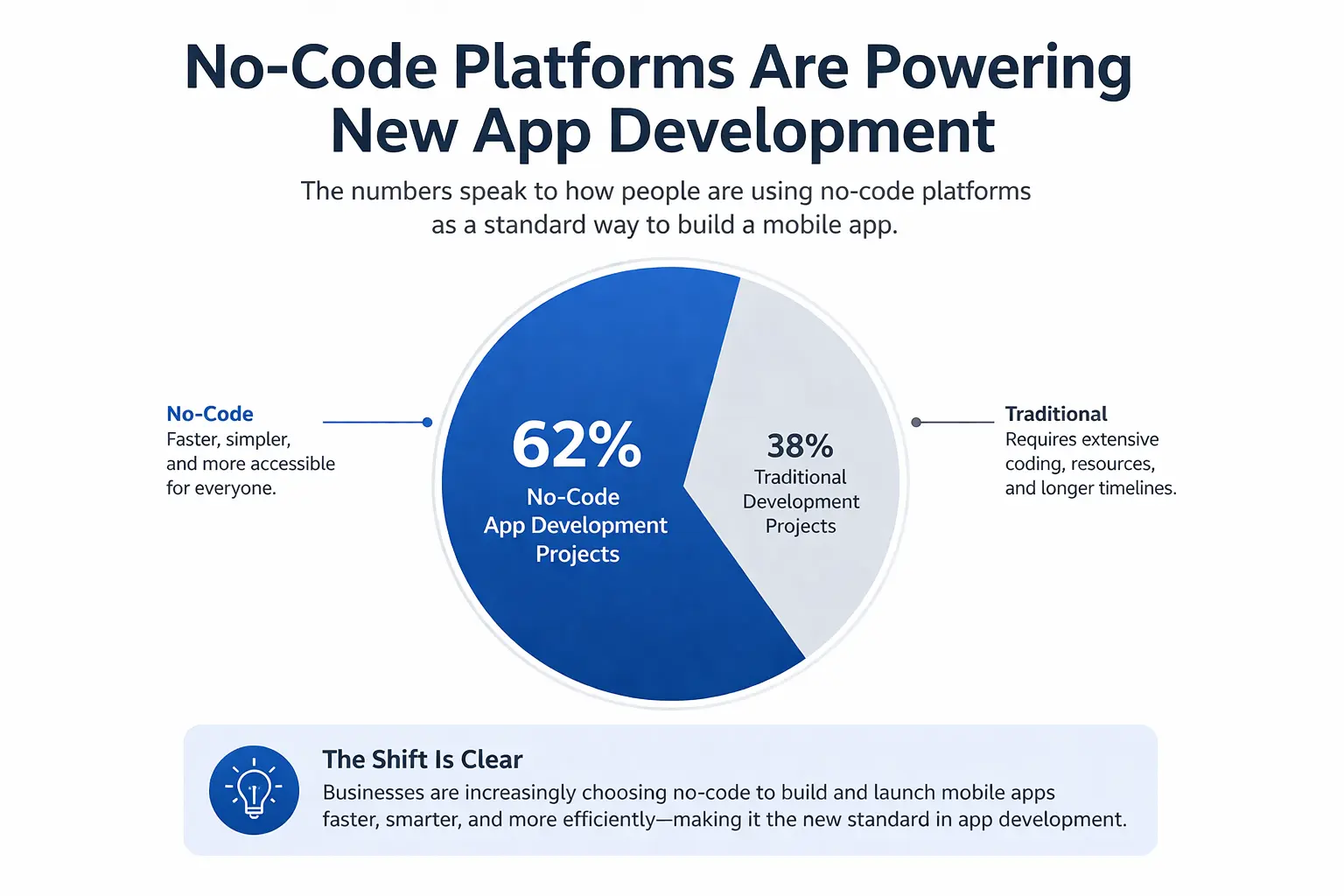
According to Base44, no-code platforms power 62% of the new app development projects. The numbers show how people are using the no-code platforms as a standard way to build mobile apps.
Nowadays, no-code app platforms manage everything from logic building to publishing the apps on app stores. But with many platforms available, choosing the right platform for your business is essential.
This blog will guide you through what no-code app builders are, their benefits, choosing the right mobile app builder, mistakes, and the best no-code app builders for your business.
What are no-code mobile app builders?
No-code mobile app builders let you build fully functional mobile apps without coding. It uses drag-and-drop elements and pre-built templates to design how your app will work and look. It bridges the gap between advanced technology and businesses with a non-technical background.
WebToNative is one of the best no-code mobile app builders. Modern no-code app platforms manage both frontend and backend logic, development, deployments, and databases. For instance,traditional app development takes six to nine months for developers and the team to develop a basic mobile app. Now, all of this takes a few days to a few weeks to build an app with advanced features and a visually appealing interface.
Benefits of a no-code app builder platform
With no-code app builder platforms, businesses are building powerful apps without waiting months and extending their budget.
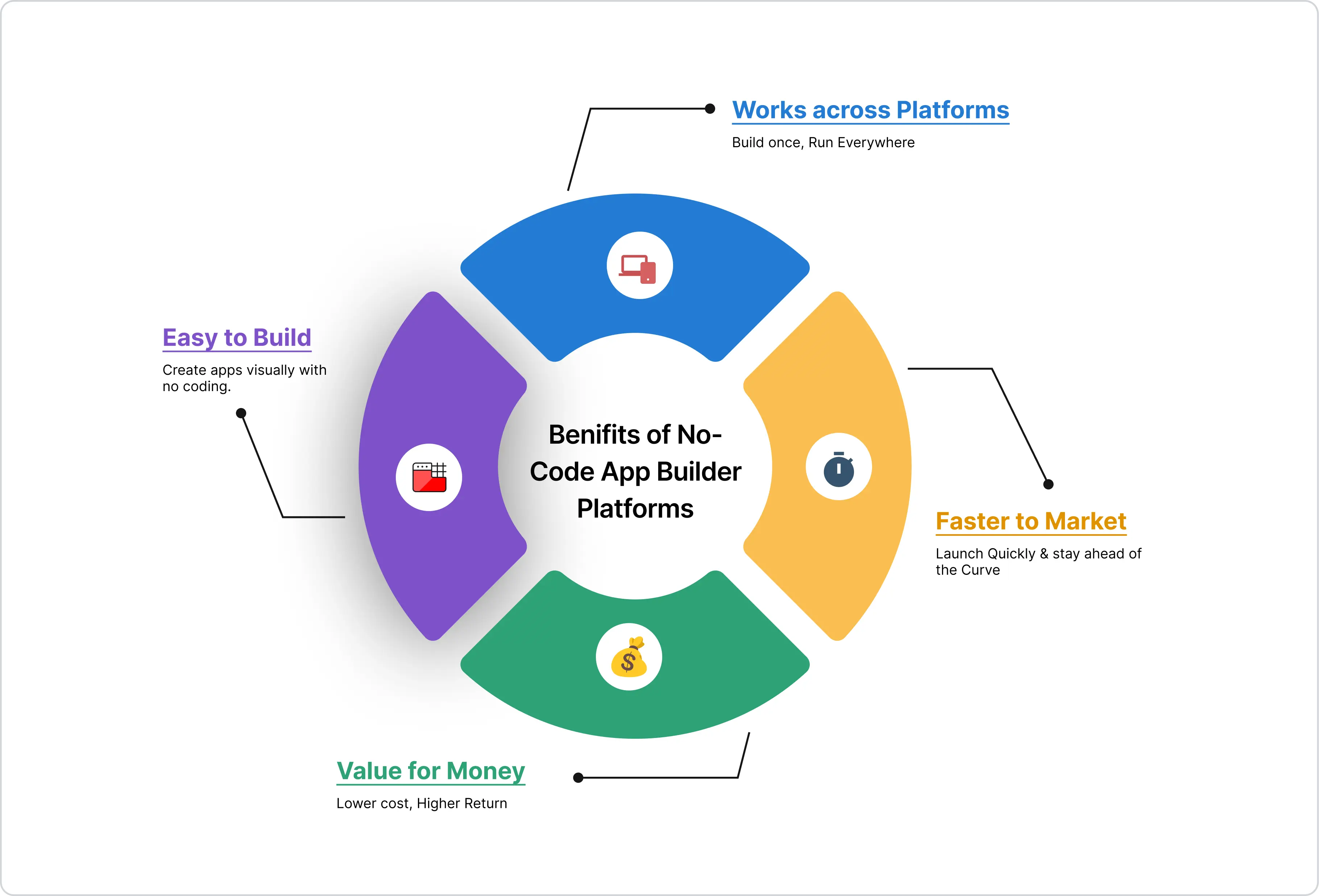
Below are a few benefits of no-code app builder platforms.
1. Easier to Build
No-code mobile apps do not require any coding, technical knowledge, or experience. Using visual editors, pre-built templates, and elements makes the development process easier and faster for people. A fashion designer, a non-tech founder, a freelancer—anyone can build their mobile app based on their preferences.
2. Works across Platforms
Apps built with no-code app development platforms create mobile apps across multiple platforms. So, you don't have to build the app again for a different platform. This depends on the no-code app platform you choose and the range of platforms it supports, including Android, iOS, Linux, Mac, and Windows.
3. Faster to Market
Many no-code platforms provide 24/7 assistance to publish your mobile app on the Play Store or App Store. For startups and growing businesses, these platforms are a powerful and budget-friendly approach to developing their app. You don't need any developer or marketer to launch your mobile app. Additionally, you just have to follow the guidelines properly for a successful launch.
4. Value for Money
Traditional app development is expensive, requiring monthly development and maintenance costs, leading to a growing budget. No-code app builder platforms reduce the cost of development by replacing coding with visuals and pre-built workflows, cutting down more than half of the cost in traditional app development. It is ideal for every business, as most of the work is automated, and you only spend on enhancing the functionality of the mobile app
5 Reasons Businesses are Shifting to No-Code App Builders
Businesses moving towards no-code app builders is a change to maintain balance between evolving customer requirements, market trends, and technology advancements.
1. Experimentation is Affordable
Earlier, working on new features used to take months of development with a proper cost, without knowing whether it would work for your mobile app or not. With no-code app builders, working on a new feature is faster with no budget. You just have to test and view its functionality to decide if it will work or not.
2. Aligned with Market Trends
Market trends change with customers' growing requirements and technology advancements. Businesses that depend on a traditional app development approach cannot align with market trends due to long development cycles. With no-code app platforms, you just have to modify the app to make it go hand in hand with market trends in real-time.
3. Scalable as Business Grows
As your business grows, your app needs to grow. With traditional app development, businesses require higher budgets, rebuilds, and development. Apps built with No-code app builder platforms are focused on growing as the business grows. People add new features or add-ons while removing outdated features without long development cycles.
4. Enhanced Team Collaboration
No-code platforms improve the communication between technical and non-technical members. Both of them can visually view what is being built, how it will work, what advancements can be made, and what challenges may arise. It keeps the members aligned, focused, and consistent with the app and its requirements.
Every reason stated above works as a benefit for businesses choosing no-code app platforms over traditional app development.
How to choose the right no-code mobile app builder
Many no-code app development platforms exist. Choosing the right one is a bigger task.
Below are 7 must-have measures you should consider when looking for a no-code mobile app builder for your business.
1. Support and Assistance
Look for platforms that offer 24/7 guidance, detailed documentation, and guides so that you spend more time developing the app. A quick support team response can help you solve problems faster and easier.
2. Flexible and Scalable
The features you added today will not be required in the future. So, choose a platform that does not limit your growth as the business grows. The platform should offer you the ability to add new features or advancements without beginning from scratch.
3. Simplified Navigation
No-code platforms are focused on you building your own app. Search or take free trials for platforms with an intuitive interface so you don't waste time on finding how the platform works and focus on building the app. The best you can do is to look for platforms providing a live demo or preview of your app.
4. Integrations
Your app cannot be fully capable of operating all functionalities. It requires integration with other apps and tools to make it more powerful. The chosen platform should support multiple integrations, including CRMs, payment gateways, APIs, push notifications, and more.
5. Pricing
Mostly, no-code app platforms offer free to enterprise-level pricing plans. Understand what you will get in plans, such as features, functionality, add-ons, and maintenance costs, before making the purchase.
6. Reliable Security Measures
Make sure the platform has proper and reliable security measures, such as handling personal information, data protection, compliance, and permissions.
7. Cross-platform compatibility
Every business wants to reach a wider customer base, which is not possible with an app built for a single platform. You need a platform that supports multiple platforms, such as Android, iOS, Mac, Windows, and Linux. Make use of a single code to rule on multiple platforms.
The right no-code app builder platform is not expensive or popular. It is one that delivers all your requirements, making you grow from the app.
7 Must-have Features in No-Code Mobile Apps
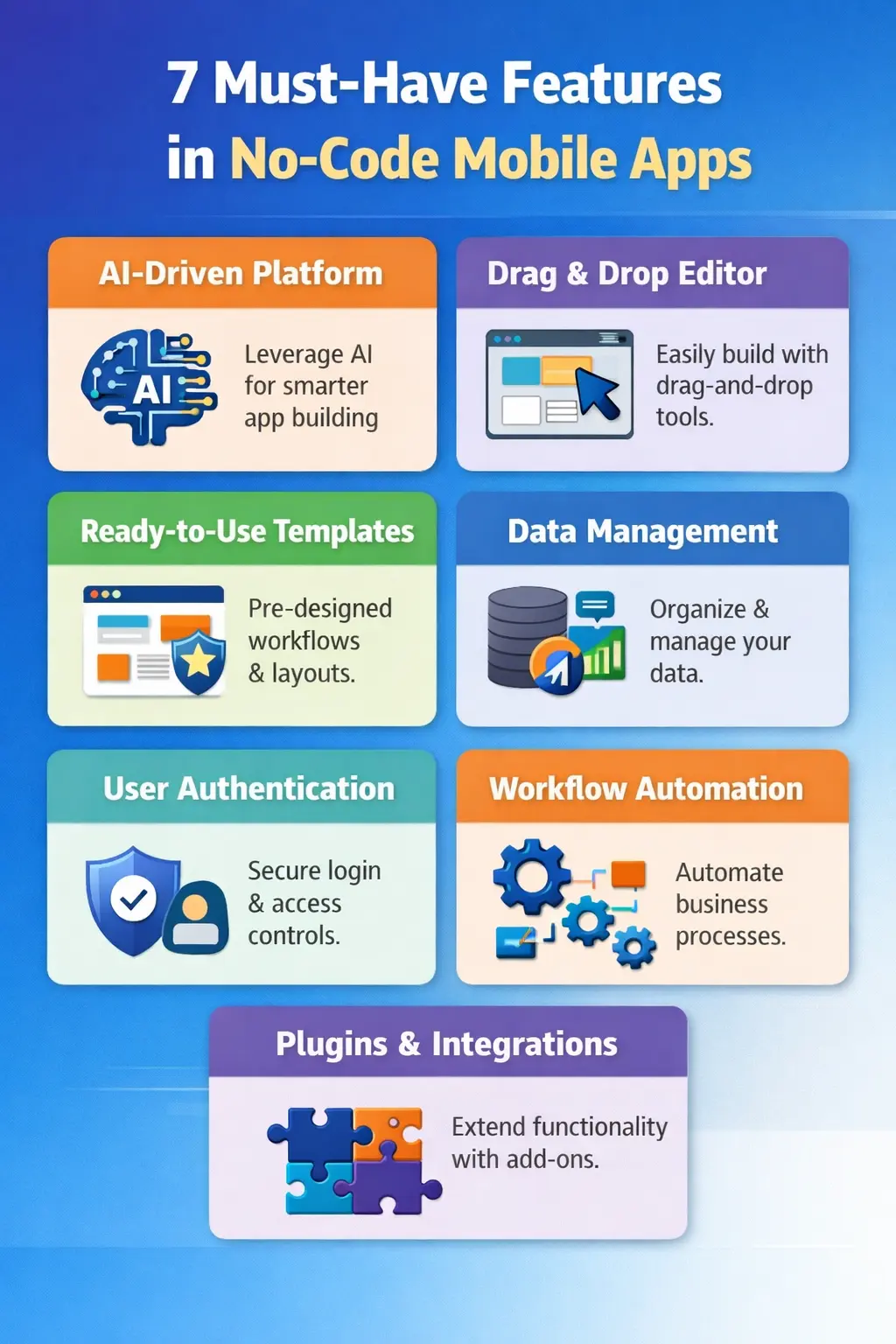
Searching or exploring for no-code mobile app builders that are right for your business. Listed below are some features that a no-code mobile app must have.
1. Drag-and-drop Editor
The drag-and-drop visual editor is the core feature of no-code app platforms. It offers users the ability to exactly view what they are building and where to place buttons, images, content, and layouts across screens without complex coding. In addition, it reduces the friction between imagination and what is being built.
2. Pre-built templates and elements
Platforms offering pre-built templates and elements help businesses to structure the app more efficiently. This feature makes it easier for users to view what, how, and where elements can be used. It includes logins, sign-ups, forms, dashboards, and purchasing pages.
3. Data Management
The right no-code app builder will let you connect your app to the current database. Whether you update layouts, checkout pages, or buttons, everything updates in real-time in your app. This is what makes a no-code mobile app more scalable than a mobile app built with a traditional app development approach.
4. Effective Authentication
Users often look for their security and privacy inside a mobile app. Businesses want this trusted authentication in their app for a reliable user experience. It includes protecting personal information, permissions, and access controls without breaches.
5. Automated Workflow
An ideal no-code platform will automate your repetitive tasks, such as email triggers, form submissions, account verification, and notifications. This saves time and reduces the need for repetitive communication.
6. Plugins Support
A no-code mobile app is known for its timeless flexibility and enhanced app functionality, allowing you to integrate multiple apps and plugins, extending your app’s functionality. As the app extends, it is eligible to meet future user expectations and market trends before time.
7. AI-Powered Platform
Modern no-code app development platforms let you describe your app in natural processing language. The platform will automatically generate the screens and basic functionality for the app. It makes the app development process faster and simpler for non-technical users.
Common Mistakes When Using No-Code App Platforms
Businesses think that with no-code app builders, they can build an app without any mistakes or challenges. Below are a few common mistakes to avoid before building your no-code mobile app.
1. Unmatched App logic with no-code platform capabilities
Before choosing the no-code app builder platform, businesses should clearly define the apps' logic, including essential functionality, basic features, and workflow. They must check if the no-code platform can meet all the app logic requirements. If the app logic is not proper, it will only waste your time, money, and effort.
2. Improper App workflow
The most serious mistake is improper app workflow. It means you haven’t created a structured app workflow. For example, when a user opens the app, what will be the first screen or page to appear in the app, and clicking on the account verification button will redirect the user to which page. Either build an app with a no-code app platform, or it is a must-have before building the mobile app.
3. Unclear market research and app ideation
Businesses build a mobile app either to be in competition or to enhance their digital presence. But they forget to research the ongoing market trends, the purpose of building an app, the problem it solves, and how users can interact with the app. Building an app that nobody needs or that your competitors have already built is a waste of time and resources.
4. Neglecting the user interface and experience
A mobile app with a complex user interface can irritate users and make them leave the app without even properly using it. Many businesses focus on features and functionality, ignoring the app’s interface, which can directly impact the user experience.
5. Ignoring Data Security
Businesses that manage personal information, payment data, user bank details, or other sensitive information cannot afford to breach their privacy at any cost. Many no-code app builders lack proper security and privacy measures.
No-code app development platforms are powerful, but you cannot plan what you want from the app. Proper preparation and research can benefit you in the long term.
Top 6 Best No-code Mobile App Builders in 2026
In the upcoming technology-first world, no-code mobile app builders will be more powerful for businesses to build mobile apps without complex coding and higher development costs. It has made it possible for every business to launch an Android and iOS mobile app faster than others.
Below are the six best no-code app builder platforms leading in 2026.
1. WebToNative (RECOMMENDED)
WebToNative is a powerful no-code mobile app builder. It converts the existing website into a publish-ready mobile app for Android, iOS, Mac, Linux, and Windows without coding and technical knowledge. The platform uses the complete website to deliver an unmatched mobile experience with native functionality and features. For businesses that require a faster and budget-friendly no-code app platform without hiring developers, their search is over with WebToNative. It is best suited for every business, from a startup to an enterprise level, with premium pricing and higher-value results. Take a look at WebToNative’s Pricing Plans for your business.
-
Push Notifications with OneSignal integration bring customers back again and again. Go through WebToNative’s Features and Add-ons for more information.
-
One codebase and publish your mobile app on different platforms to build trust, credibility, and brand visibility.
-
Advanced plugin integrations from payment gateways to biometric authentication.
-
Offline native functionality keeps users engaged without an internet connection.
2. Median
Median delivers a fully functional mobile app by wrapping your current website into a mobile app. It allows access to the device-specific features through the JavaScript bridge. The platform is best suited for middle- to large-level businesses that require deeper integrations. The platform is complex to set up, and higher pricing plans make it less suitable for startups and small businesses.
-
JavaScript offers camera, contacts, and GPS access.
-
Complex setup leads to slow app launches.
-
Deep linking allows sending users from ads directly into the app.
3. Bubble
Bubble is a web application builder with databases, user authentication, and workflows. It is an ideal solution for startups and entrepreneurs wanting to build a website without coding and complexity. The platform is primarily website-first and then converted into a mobile app with additional cost.
-
Multiple plugins, such as APIs and other integrations.
-
For a native experience, more effort and a higher plan are required.
-
Database, user interface, and logic in one place.
4. Adalo
Adalo is a drag-and-drop mobile app builder, especially for non-technical individuals. It helps users to design screens visually, integrate a database, and publish the app. The platform is ideal for no or less complex applications. However, it is less reliable in terms of scaling up, performance, and app logic for growing businesses.
-
Handle the App Stores' publishing automatically.
-
Pre-built components for faster speed.
-
Harder to manage larger amounts of data and more users.
5. Twinr
Twinr is a website-to-app converter platform, especially for small businesses. It offers basic native features such as biometric authentication and push notifications. The platform is best suited for simple websites with basic functionality. It lacks advanced integrations as compared to WebToNative.
-
Biometric authentication adds a proper security measure for users.
-
Apps are published within a day, which is great for a quick app launch.
-
Limited customizations and features can limit the app’s growth.
6. AppMySite
AppMySite is a tool that converts a website into a mobile app, especially WordPress and WooCommerce websites. It supports powerful e-commerce features, such as cart synchronization, order tracking, and product listing. The platform is limited in practical use.
-
Push notifications for order alerts and updates.
-
WordPress plugin integration
-
WooCommerce into a complete shopping store.
Each platform has its own capabilities, but for each business type, WebToNative stands apart. The speed, simplicity, and value all inside one platform are advantageous in the long term.
FAQs
Q1. What is the difference between no-code and low-code app builders?
A. No-code app builders let you build a mobile app without coding. Low-code app builders let developers add small custom code for logic building and integration.
Q2. Which is the best no-code app builder platform?
A. WebToNative is the best no-code app builder that easily converts websites into a mobile app for Android and iOS without coding and technical skills. It offers a wider range of features, unlimited app customizations, and plugins for your mobile app.
Q3. What is the most common mistake businesses make while building a no-code mobile app?
A. Businesses do not focus on the workflow of the app or current & upcoming market trends. These are two mistakes that are often ignored, leading to a waste of time and resources.
Q4. What is the one must-have feature in the no-code mobile app every business wants?
A. The push notifications feature is most needed in no-code mobile apps. It is one of the easiest and most highly engaging features for businesses to remind users and keep them coming back to the app.
Q5. Are no-code app builders expensive for small businesses?
A. No, no-code app builders like WebToNative are not expensive. This is a budget-friendly platform with premium features and add-ons. View WebToNative’s Value-Rich Pricing Plans.
Build Smarter with No-code App Platforms
The rise of no-code app builder platforms has made building a mobile app easier for every business. This journey is simpler and quicker from understanding what no-code app builders are to the best no-code platforms. The essential thing is to know the purpose of your app, choose the right platform, include the required features, and avoid mistakes. It does not depend on whether you are building a mobile app or making more advancements. With the perfect no-code app development platform, your app’s presence should grow as the business and market grow.
Similar Blogs